




Organizations have adopted artificial intelligence at unprecedented speed. Few have yet to see it change how work gets done.
The gap is not technical; it is adaptive. For chief learning officers, the question is less about how to implement AI, but rather how to help people adapt alongside it.
The AI adoption paradox
Over the past two years, AI has moved through organizations faster than any workplace technology in memory. By late 2025, McKinsey & Company reported that nearly nine in 10 organizations used AI regularly in at least one business function.
While enthusiasm leads, returns lag. Drawing on more than 300 enterprise deployments, MIT’s Project NANDA revealed that roughly 95 percent of generative AI pilots produced no measurable profit-and-loss impact.
While this could point to a pilot-to-production problem, MIT NANDA researchers suggest this is a learning gap: tools were adopted, but learners did not meaningfully change how they worked. Success, they concluded, hinges on the approach and not the technology.
Harvard leadership researchers introduced the adaptive leadership framework to emphasize the idea that change is the norm in organizations. Adaptive leadership distinguishes between technical challenges, which can be solved with existing expertise and adaptive challenges, which requires people to learn, adjust and change their behavior.
Organizations that treat AI as a technical challenge miss how it alters professional identity, redistributes expertise, blurs accountability and raises pressing questions about who benefits and takes on risk.
Leader mindsets and AI adoption
AI adoption skills depreciate as fast as tools change. Mindsets are the built capacity leaders need for the AI era. A leader’s mindset determines whether they see AI as a threat to control, a lever for headcount reduction or an opportunity to redesign work around human strengths. This mindset also mediates how AI is experienced by people in the leader’s organization.
The learning remit must transcend AI training to build a responsive learning ecosystem in which people can openly question outputs, develop judgment, practice new ways of working, preserve essential expertise, create new trust norms and participate in redesigning work.
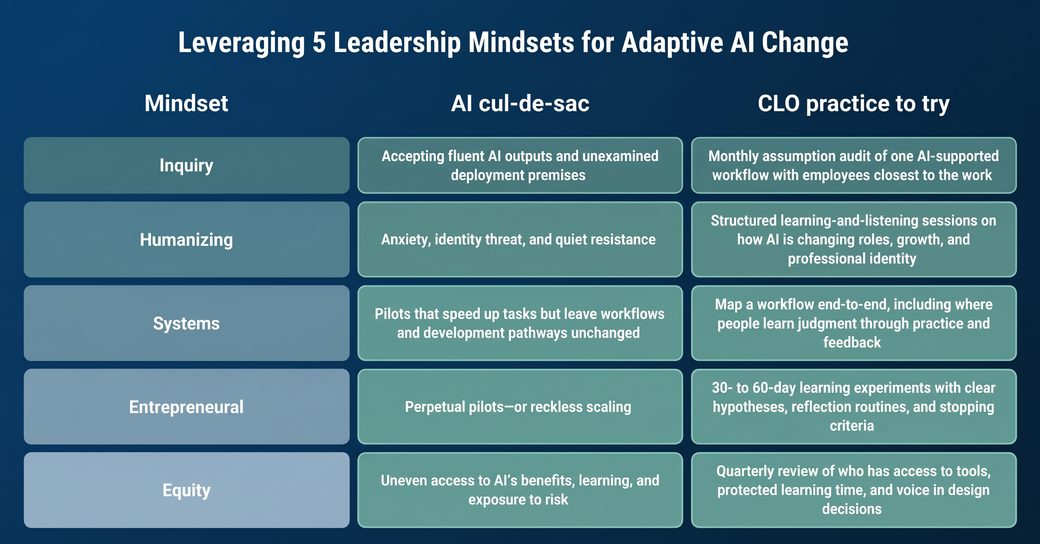
The Flux 5 is a leadership framework built around five mindsets: Inquiry, humanizing, systems, entrepreneurial and equity. Together, they help leaders move from AI adoption—and avoid getting stuck in the figurative AI cul-de-sac—to adaptive workforce development.
1. Inquiry Mindset: Question the output and the premise
An inquiry mindset—an intentional learner stance committed to questioning norms and surfacing invisible organizational logics—becomes an essential safeguard in an information environment prone to err. Inquiry in the AI era operates at two levels: the output: building the habit of and flows around interrogating AI production, and the premise: examining assumptions embedded in AI-specific decisions. What problems are we solving? Whose priorities are driving this use case? What will change once this process is automated?
For CLOs, this means moving from AI training to work-embedded learning. Employees learn by comparing AI outputs with expert judgment, verifying claims against trusted sources, identify misses and sharing observable patterns, ultimately building disciplined discernment, a capability more valuable than prompt fluency alone.
Key practices
AI assumption audits: Each month, select one AI-supported decision or workflow and generate authentic spaces of dialogue: What does this tool assume about our [work/clients/customers/people]? What would we see differently without it?
Rapid-cycle inquiry on adoption: Use short listening cycles such as flash focus groups and brief pulse questions to surface how employees are using AI, where it helps and where they are working around it.
Judgment labs: Use real work artifacts to help teams compare AI output with expert analysis, identify errors or missing context and articulate indispensable human judgment.
2. Humanizing mindset: Hold people through the transition
AI anxiety is widespread, and it is rational. Employees are being asked to adopt tools that may reshape or eliminate parts of their roles, often without clarity about organizational intent. When leaders frame AI as a productivity lever, distrust mounts—through knowledge blocking, minimal compliance and silent resistance. A humanizing mindset centers people, purpose and presence, asking leaders to attend to the relationship between technology and professional identity.
For CLOs, this means protecting the developmental experiences through which people build expertise. With AI doing the foundational work that once promoted reasoning, writing, analysis and feedback loops, organizations must intentionally redesign those pathways within this new frame.
To be effective, learning must be humanizing. Here, we build on organizational behavior professor’s Gianpiero Petriglieri’s concept of institutional holding. Like children, adults experiment, learn and thrive best when held in safety. Today, learning and development must offer a holding environment and scaffolding for AI questions, concerns and learning within a culture of care and transparency.
Key practices
Story the gaps: Create structured spaces for employees to share how AI is changing their work, including gaps between what leadership says about AI and what people experience.
Transparent—if dynamic—intent statements: Articulate organizational intent and revisit those commitments publicly as conditions change.
Protect—and redesign—the development pipeline: Identify entry-level ways through which employees practice judgment, then redesign as AI-augmented.
3. Systems mindset: Redesign the workflow and ecosystem
The most common AI cul-de-sac is local optimization—a tool that creates singular or scattered efficiencies without impacting the broader workflow; impressive usage albeit negligible impact. A systems mindset helps leaders acknowledge and avoid this cul-de-sac with the introduction of systems concepts such as interconnectedness, synthesis, emergence, feedback loops and causality presents pressing questions. If this task gets faster, where does the work go next? What feedback loops will AI create or break? What happens when AI-generated content becomes the input for other AIs? Where are the leverage points where a minor structural change leads to a major shift?
Here, CLOs have a distinctive systems role: identify the hidden developmental consequences of workflow redesign.
Key practices
Map before automating: Before deploying AI in any workflow, map it end to end, from decision points to dependencies, to identify where gains will be absorbed or lost.
Understand the learning flow: Alongside the operational workflow, identify where employees gain practice, feedback, mentoring and tacit knowledge. Determine what AI changes and what must be deliberately rebuilt.
Track the system: Replace usage metrics with outcome measures tied to the whole workflow: cycle time, quality, customer experience and employee capacity.
4. Entrepreneurial mindset: Experiment with disciplined curiosity
Organizations fall easily into one of two AI traps. Some get stuck in perpetual pilots—testing endlessly, scaling nothing. Others scale too fast, committing enterprise-wide to tools and vendors before understanding the work those tools are meant to change. Both can be avoided through disciplined experimentation. An entrepreneurial mindset is well-matched to a rapidly changing landscape.
The entrepreneurial question for the AI era becomes: What does this moment make possible that wasn’t possible before? For CLOs, disciplined experimentation is a learning design principle. Pilots should generate reusable knowledge. One that is limited to a deployment decision has shed much of its learning value.
Key practices
Bounded experiments: Run 30- to 60-day AI experiments with clear hypotheses, success measures and threshold criteria defined in advance, rendering stopping a decision rather than a failure.
Learning reviews, not just project reviews: At the end of each pilot, convene participants to document the skills, judgment calls, workarounds and coaching needs that surfaced, to inform future learning design.
Frontline opportunity scanning: Invite the people closest to the work to identify where AI can remove friction. They often see high-value uses.
5. Equity mindset: Distribute the gains and the risks
AI does not distribute its benefits or its risks evenly. Access to tools, training and time to experiment often trace existing hierarchies, exposing to automation a demographic frequently with the smallest voice in AI deployment. Models trained on historical data can reproduce historical biases in hiring, evaluation and service delivery. Without deliberate attention, AI can widen gaps organizations have committed to closing, while appearing neutral and objective.
Equity in the AI era is a matter of organizational performance; concentrated AI fluency influences organizational capacity to adapt. When people across roles and levels have access to AI tools and learning, the organization gains a broader base of experimentation, insight, and resilience. The CLO’s responsibility is not only to expand access to tools but to the time, support and developmental opportunity required to move from new capability to new opportunity.
Key practices
AI equity reviews: Each quarter, examine one AI deployment and ask who gains capacity, who absorbs risk and whose perspectives were missing from the design.
Democratize access, learning and opportunity: Make AI tools, role-relevant learning, coaching and protected time to experiment available across roles and levels. Link demonstrated responsible capability to internal mobility and stretch opportunities.
Bias checkpoints in high-stakes use cases: Require human review and equity-focused testing wherever AI informs decisions about hiring, promotion, evaluation or service to the public.
Potentiating humans in the AI era
Together, these mindsets potentiate people-centered, learning-oriented AI adoption and integration.
CLOs can begin by assessing which mindset their organization’s AI strategy most neglects. Rebalancing requires a layered practice cadence. Some activities weekly—listening, reflection and workflow awareness; others monthly or quarterly—experiments, audits and equity reviews.
AI is an iterative learning process
AI is not a destination to reach and then stabilize around; it is a learning process that builds on itself.
Capabilities will continue to shift, reopening the adaptive questions of identity, trust, structure, opportunity, and fairness. Adaptive change is the condition, and AI is now its fastest accelerant, all rendering the CLO’s role increasingly central to cultivating the questions, judgment, trust, systemic awareness, disciplined boldness and commitment to fairness that create sustainable organizational value.
The question is not whether your organization will adopt AI (it already has) but how to help its leaders build and sustain the learning capacity that people-centered AI adoption demands.