



As artificial intelligence-generated images, videos and audio rapidly become less distinguishable from reality, organizations are entering a new and largely unexamined phase of disruption—one that is less about technology adoption and more about trust, meaning and human perception.
While learning and development professionals and leaders are being asked to adopt AI tools, guide ethical use and prepare employees for rapid change, very few have been equipped to address a quieter but more consequential challenge for leadership development:
What happens when employees no longer trust what they see, hear or are asked to believe?
In short, AI may be accelerating one of the most overlooked leadership challenges of the last decade: distrust.
The experiment
A recent ABC News Australia experiment tested whether Australian teens could differentiate between real and AI videos. They paid close attention and made educated guesses based on things such as the movement of an umbrella into the frame, the smoothness of water flowing over a bridge and the dirtiness of a boat window. However, those things didn’t help them accurately guess because AI has become so proficient at mimicking reality. The participants only guessed accurately 67 percent of the time.
I showed this same video to a group of internal employees in one of our monthly innovation lab meetings, and we found ourselves in a very similar position: We couldn’t identify which were real or AI-generated.
The treachery of images
Why is it difficult to accept the “treachery” of AI images? Because people don’t like to be duped or tricked by something masquerading as real.
This conundrum reminds me of René Magritte’s much-reproduced and now-iconic surrealist painting “The Treachery of Images,” better known as “Ceci n’est pas une pipe,” which translates to, “This is not a pipe.” The painting asks viewers to consider the rupture between the word we use to signify something (or the pictorial representation) and the thing itself. Quite literally, the image above is not a pipe. It is one artist’s representation of a pipe as filtered through their consciousness.
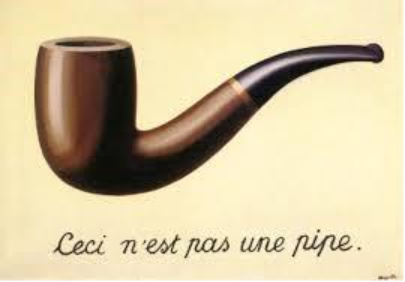
When it comes to AI-generated video or photography, we often have greater difficulty understanding them as merely “representations” of reality. We sometimes forget these videos aren’t the whole truth or “real” either. Each video or image is created through that lens. Some elements will be omitted, and vantage points will be obscured. Some details will have been missed, and others will have been highlighted.
Unlike paintings, which we very clearly understand as “representation,” we have come to think of videos and pictures as “real.” They are used as evidence in court. We post them to prove that our realities and experiences are genuine (“Pics or it didn’t happen!”).
But despite Photoshop and other tools we use to alter content, we have not had difficulty differentiating “real” or unaltered versions from the “fakes.” That was true when AI first arrived on the scene, as well. It left traces—third limbs, floating hands and plastic smiles—until now.
The ”treachery” of what we’re seeing all over the internet and social media, where we can often no longer discern if something is real or not, is a crisis that has a kind of philosophical lineage if we’re willing to entertain it.
Perhaps, we must understand these forms of media as we would paintings and other representative art, as representations in search of meaning, for pleasure and critique, but not as mediums of “truth,” and certainly not as “real.”
The impact
What happens when employees feel chronically “duped” by these media? Distrust becomes the norm in new relationships. The question I posed to my internal group during our innovation lab office hours, after watching the ABC News experiment, was not about AI technology per se. As someone who works in the business of people development, I’m more curious about the emotional and psychological impact of this rupture between representation and reality.
So, I asked my group: “What is the impact on workplaces when our employees feel like they can no longer trust anything they see, watch or hear? If we have already seen spikes in topics like mistrust in the workplace, leader authenticity and organizational transparency, what happens to relationships in the workplace when people come already looking for the trick?”
In other words, what happens when it’s no longer clear to the viewer that what they’re seeing is “not a pipe?”
Their answer? People begin from a position of skepticism, guardedness and distrust. The baseline in new relationships is no longer neutral, as you wait to see if someone will be true to their word or not, do what they say or be unreliable, be someone who creates safety or is toxic. If we follow this line of reasoning, the baseline is a deficit of trust from the start.
At this point, the comment section of every video or image post online contains at least one person positing, “AI!” or “AI. Fake news.” People get mad at one another for being fooled and frustrated at the original posters for circulating “AI slop.” It has me second-guessing my own assessments of those things, even if I felt assured that AI was not used to manipulate the video or image.
In an era when calls for truth and transparency abound, the inability to trust what we are looking at is causing real issues.
At first glance, this might seem like a trust problem. But I found myself wondering whether trust and distrust are actually the same thing. If employees are increasingly entering workplaces already looking for the trick, the hidden agenda or the catch, is distrust simply the absence of trust—or is something else happening?
Trust and distrust: 2 sides of the same coin?
A study on trust and distrust using fMRI imaging challenges the assumption that trust and distrust are two sides of the same coin. The study found, instead, that trust and distrust activate different brain regions, confirming that they are two distinct concepts associated with their own divergent neurological processes.
Angelika Dimoka explains: “Trust is associated with brain areas linked to anticipating rewards, predicting the behavior of others and calculating uncertainty. Distrust is associated with brain areas linked to intense negative emotions and fear of loss.”
Distrust, as it fires up the insular cortex and amygdala, activates emotionally laden, autonomic responses that have a “stronger, emotional component than trust.” Perhaps one of the most interesting takeaways from this study was that in treating trust and distrust as distinct processes, we begin to understand that we can’t focus solely on building trust.
What does it mean for organizations or leaders? There must also be an intentional effort to reduce distrust.
A call to action
You might be asking yourself, “What does that have to do with work, my employees or their jobs?”
Let’s think about that word “duped,” for a moment longer. Yes, the fear of being “duped,” as in tricked or fooled, is creating friction. But I would argue that the AI backlash has much to do with the fact that people also don’t like to be duped, as in duplicated or replicated, as well. In this more nefarious instance, the prospect of AI doesn’t just threaten their pride, ego or sense of reality; it threatens their very personhood, livelihoods and existence.
The ongoing turmoil in the workforce and the market doesn’t seem to be letting up. And in a world where headlines indicate that machines can now do the work once done by people, the fear that undergirds so much of the everyday is the stuff of science fiction…except it feels more tangible and possible than ever as we watch organization after organization make reductions in force and AI programs replace people. It’s no longer a stretch to imagine oneself as duplicable, replaceable and unnecessary.
Our efforts to create a sense of safety and trust among our employees must address these fears. And that might look different than you imagine. Our job as leaders is not to paint a rosy picture of the future, provide hollow comfort or boost morale with trinkets, swag and other incentives. Moreover, we can’t simply dedicate ourselves to building trust practices. We must also begin actively reducing the distrust linked to those “intense negative emotions and fear of loss” that employees are exposed to, day after day.
What we have to offer
In the absence of real certainty to offer, the next best thing we can give our employees is frankness or candor that offers a hefty side of compassion. It’s leading with real conversations that are as transparent as possible, allowing them to plan for outcomes A, B and C without being blindsided by “pink slips” and to address the fear of uncertainty in a constantly changing landscape. It’s saying “I don’t know, but I’ll find out” as often as you have to.
Diminishing distrust requires organizations to be a little vulnerable and to show their hand ahead of the final reveal, so that the big decisions that come feel less like “gotcha” moments that replicate the feeling of being duped or tricked and feel more like moments where people have “gotten real” together and understood what was on the table.
The next time you have an employee who seems skeptical of everything and is pessimistic in their outlook in ways that feel unfair, out of context or disproportionate to whatever issue you might be dealing with, take a moment to consider the crisis of truth we are living through.
Remember that leaning on trust-building strategies is a great start, but without also working to diminish distrust and the intense emotions activated by fear, we’ll likely remain in a deficit. Bringing our people back to baseline means acknowledging that the monsters under the bed might be real this time, but assuring them that they have an ally in figuring out how they’ll vanquish it.