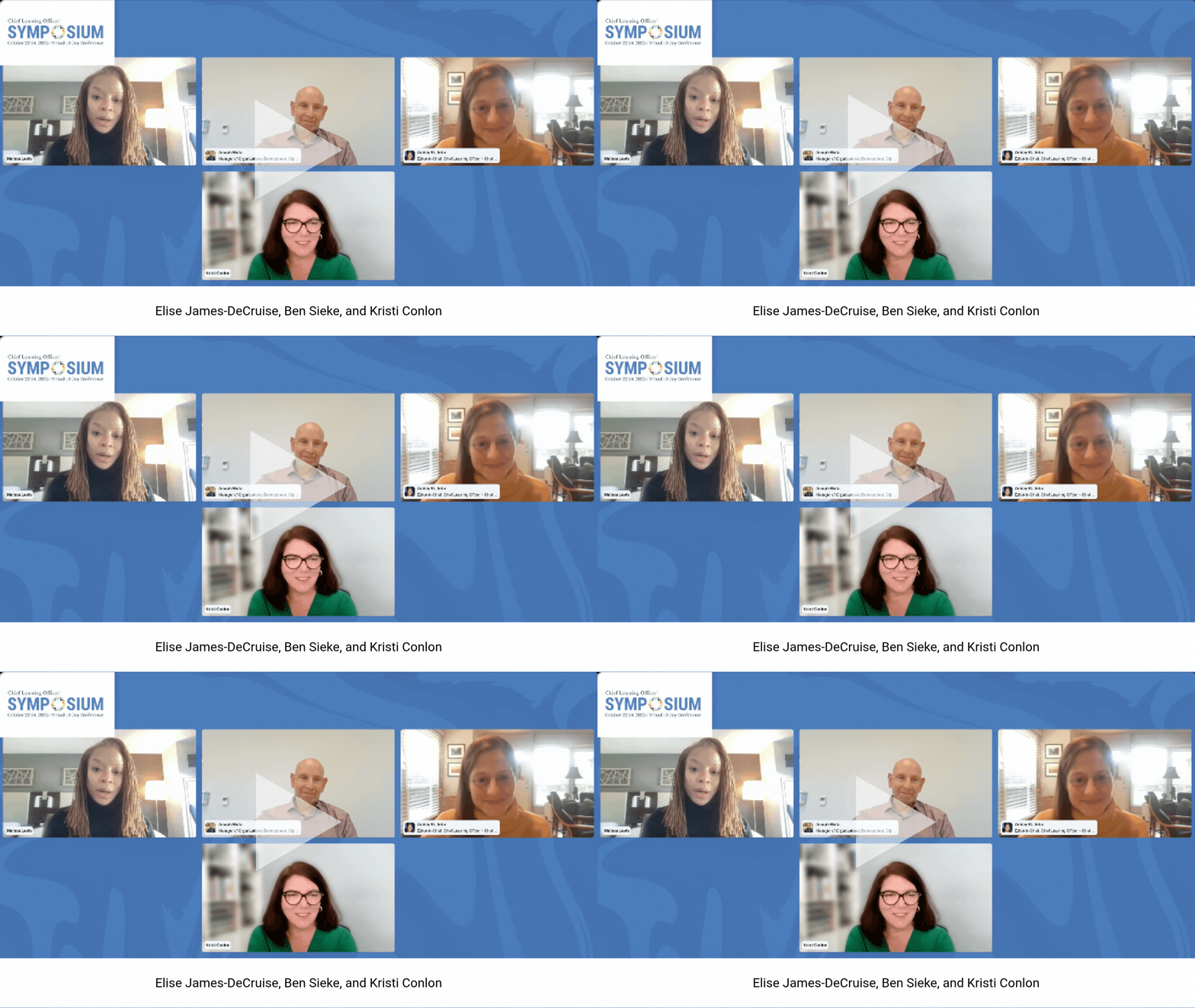



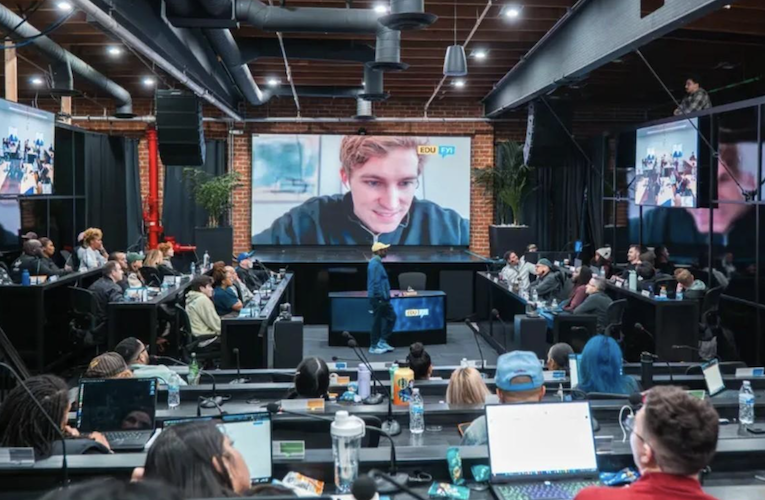
I was in the room where it happens. I was part of the first cohort of Arizona State University’s The Agentic Self course, something will.i.am (the front man for the hip-hop group Black Eyed Peas) and ASU imagined in 2025. Professor Will, as we called him, had already created the FYI campus in Hollywood: a magical hip-hop version of Willy Wonka’s factory, but instead of chocolate bars, it manifests music, products and now … people empowered to build in an AI world to make a better real world.
As he worked with the ASU president and professors, Professor Will reimagined and transformed a space at the FYI campus into a room for learning and collaboration. The room was designed in a U-shaped format modeled after the United Nations, with each person having their own chair and microphone, which matters when virtual guests are part of the conversation.
Being in that room changed how I think about agency, curiosity and what it means to stay human-led in a world of AI agents. And it raised a question I have not been able to stop thinking about: What if organizations created the conditions for their people to have that same experience?
“Agentic self is you claiming your data and now putting it to work for you by creating an agent that reflects your beliefs, your concerns, your passions, your interests.” — will.i.am on NBCLA
What the room taught me
What I learned in that room, and through the course itself, is that you rarely know what a spark can do until you move it through different environments. The room, the people, the platform and the context all shape what becomes possible.
That’s why exploration is not a side quest; it is part of the build. In a world shifting this fast, curiosity is a capability, and courageous curiosity is one way we stay human-led. Let me share with you my story.
A spark that started it all
My idea started two years ago, when most people were talking about large language models (such as ChatGPT) as a way to become more efficient and productive. As a learning innovation professional, I saw something else: the possibility that these AI tools could not only transform how people learn about hard conversations, but how they practice and prepare for them.
That insight became the seed for a conversational skill builder. It is a way for people to practice real scenarios, receive immediate, personalized feedback, and then have guided reflection to gain insights for lasting transformation.
ChatGPT was the first place I explored it, because I wanted to know whether the idea had legs and could actually work. That first step was not the whole solution. It was the beginning of moving from idea into action.
The evolution of my idea across AI platforms
What started as a conversational skill builder in ChatGPT kept evolving as I moved it across platforms, each one revealing something new about what the idea could do.
In ChatGPT, as a learning innovator for my own curiosity, I could test the concept on my own and see whether the core interaction worked and was useful.
In Copilot Studio at Providence St. Joseph Health, as manager of learning innovation for a large healthcare system, I was trying to solve a different problem: how to author and deploy this idea at enterprise scale, inside the real constraints of organizational complexity, governance and strategic alignment.
In Acolyte, as a strategic innovation consultant for a small AI startup, I worked on this idea on their platform to easily author multimodal experiences and include avatars, opening up a richer learning experience.
And in FYI, the idea transformed again. What I found was a confirmation of something I had been building toward: an easy-to-use platform with a different set of tools and capabilities that let me move beyond a skill builder and evolve into a more personalized, guided, action-based learning experience. What crystallized here was a principle I had been circling for some time: What AI makes genuinely possible for learning and performance support is in a middle ground that has not yet been fully claimed. It is not the open-ended blankness of an empty AI prompt, which can overwhelm as easily as it empowers. And it is not the rigidity of a static PDF, a traditional course or a fixed video. It is something in between — an adaptive, scaffolded support that guides without constraining and that gives the person both structure and room to move.
That was the big surprise in the journey — not that the idea worked, but how much further it could go: from a skill builder to the concept of AI-guided mastery.
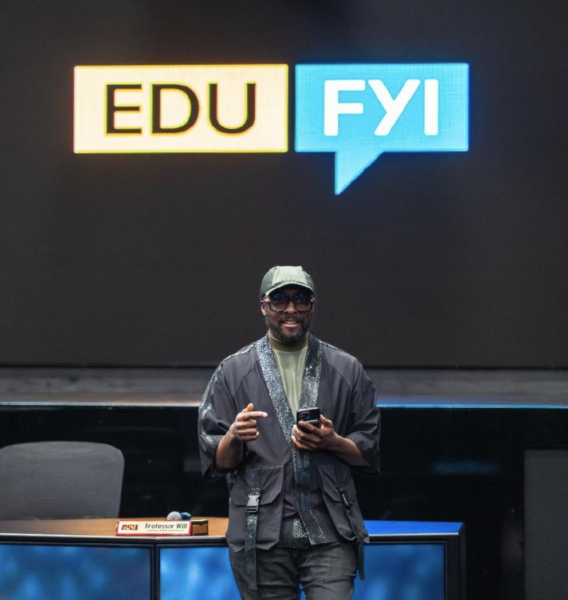
It confirmed what I had believed from the beginning: The same core spark blooms differently depending on the environment it enters. ChatGPT gave me a first test. Copilot Studio revealed the friction of enterprise-scale authoring. Acolyte showed what easy multimodal authoring could unlock. FYI showed me that the idea could become something more expansive — not just a learning tool, but AI-guided mastery through a collaborative environment. People engage through their own personally configured persona to have deeper discussions and explore guided activities so they can move from spark to action.
This is the deeper truth I want to share: When you hold an idea and keep moving it through different environments, you discover not just what it can do, but what it was always meant to become. That is what exploration really is. That is what innovation really is. And that is why curiosity is not a nice-to-have in a fast-shifting world — it is essential for success.
What this means for leaders
For leaders, founders and executives, this matters because best fit changes everything. When an idea meets the right environment, it becomes easier to adopt, easier to use and more powerful in the flow of real work. When the fit is wrong, even a strong idea can stall out. That’s why I care so much about best fit. Best fit drives better adoption, stronger internal performance and better alignment with strategic goals.
It also means the people around the work matter as much as the work itself. That’s one reason FYI matters to me. It is not just about new tech. It is about the people, their point of interest, point of view and the kind of community they are building. FYI is not for everybody, but it is for me. Professor Will leads it with a strong moral and ethical compass. What he built is a room, a campus and a tribe that feels aligned with the kind of human-first AI work I want to continue to do.
That matters in a world where AI is moving fast. Your competitors are exploring too. If they find a similar idea in a better environment, with a better platform and with a clearer path to delivery, they may have the advantage. So exploration is not extra. It is essential for success.
The same is true inside organizations, and this is where learning leaders have a critical role to play. We know from recent research that most organizations have already cleared the first hurdle: Tools are licensed, governance is in place and AI has been announced. Yet a familiar gap has appeared. A small group of early adopters moves quickly while a much larger portion of the workforce remains cautious, uncertain how AI fits their role or how to use it responsibly in real situations. The challenge is no longer access to AI. It is workforce readiness. And readiness is not a technology problem; it is a human one.
What my experience in The Agentic Self course clarified is that readiness does not come from access alone. It comes from environments that invite exploration — where people have permission to test ideas, move them across contexts and build through curiosity rather than compliance. If organizations want a workforce that is genuinely ready for AI, they need to design learning cultures that develop the agentic self, not just the skilled user. That means giving people room to explore, fail and find what fits. It also means creating the psychological safety and structural support to make that kind of exploration possible.
Brad Bigelow, the founder of Acolyte AI, who has worked closely with learning leaders navigating this exact challenge, offers this perspective:
“What I observe most often is organizations that have invested heavily in AI access while underinvesting in the structures that help people use it with confidence and purpose. The gap is rarely technical … it is typically cultural or architectural. Leaders who close that gap are not simply rolling out tools; they are deliberately designing environments where people feel supported to explore, guided to apply, and given room to build real capability over time. The distinction between being equipped and being ready is what defines which organizations will lead and which will follow.”
A version of this idea has just completed the governance process at Providence St. Joseph Health, and we are now deploying it at scale across the organization. That experience, and what it took to move from concept to enterprise reality, is a story I plan to share in a future article.
What the course changed in me
This experience did more than sharpen my thinking. It changed how I move. It expanded my view of what is changing and who is driving that change. I build now with more focused intention. I keep exploring new tools, new rooms and new ways of helping people learn, practice and prepare. I choose to be around people who ask good questions, care about the ethics of what we are doing and believe that AI should expand human agency rather than replace it.
It also confirmed something I have felt for a long time: The company you keep matters. The rooms you enter matter. The communities you join matter. And being in that room helped me see even more clearly what kind of work I want to do next.
The invitation
What I am taking from this experience is not just a new perspective on AI. It is a new way of thinking about agency, service and what it means to stay coherent in action.
The course changed my perspective.
The room changed my possibilities.
The people changed my sense of what is possible.
And the work changed my behavior.
If this resonates with you, the question I leave you with is this: What spark have you been carrying, and what environment might help it become something more? In a world moving this fast, the willingness to explore is not a luxury. It is how we stay human-led and how learning becomes the capability that drives everything else forward.
Brad Bigelow, founder of Acolyte AI, contributed original insight to the “What this means for leaders” section of this article. He and Hamilton co-authored “From AI Access to Workforce Readiness,” published by Chief Learning Officer in March 2026.