



We tried abstinence. It is not working.
This article is written for two audiences who rarely see themselves facing the same problem: chief learning officers and talent development leaders in corporate America, and faculty and academic administrators in executive education and graduate classrooms. The problem is the same. The stakes are the same. And the solution, a named, governed, sequenced practice called The Bot Check Method, is the same.
In academia, the dominant response to AI has been prohibition: AI detection software, revised academic integrity policies, and assignment designs intended to make AI assistance impossible or detectable. The instinct is understandable. If students use AI to write their papers, are they actually learning? The policy answer has largely been: Keep it out.
In corporate America, the dominant response has been the mirror opposite: adoption dashboards, AI fluency training, deployment targets, and organizational pressure to use AI tools faster and more extensively. The instinct here is equally understandable. AI is moving quickly, and organizations that fall behind may not catch up. The policy answer has largely been: Get it in.
Both responses are wrong in the same way. Neither is asking the question that actually matters: What is the human supposed to be doing while AI is in the room?
That question is not a technology question. It is a learning design question. And the research now emerging from institutions like the MIT Media Lab suggests that getting it wrong carries costs that are not metaphorical. They are neurological.
What the neuroscience is telling us
In a study titled “Your Brain on ChatGPT: Accumulation of Cognitive Debt when Using an AI Assistant for Essay Writing Task,” researchers at the MIT Media Lab led by Nataliya Kosmyna outfitted 54 university students with EEG caps and measured real-time brain activity as they wrote essays using one of three conditions: ChatGPT, a standard search engine or no tools at all.
The findings were unambiguous. Students who used ChatGPT exhibited the weakest brain connectivity across regions associated with active thinking and memory. Students working without any tools showed the strongest, most distributed neural networks. And in a fourth session, when students who had been relying on ChatGPT were asked to write without it, their neural engagement remained depressed, a condition the researchers describe as underengagement, as if the habit of deferring had already altered the pattern of cognitive activation.
The researchers named this pattern “cognitive debt”: the accumulated neurological cost of outsourcing thinking to AI over time.
Perhaps the most striking finding in the study was behavioral as much as neural. Self-reported ownership of essays was lowest in the LLM group and highest in the brain-only group. LLM users also struggled to accurately quote their own work. The tool had not only reduced cognitive effort. It had reduced cognitive ownership.
Kosmyna, speaking to IBM Think about the study’s implications, was careful about what conclusions to draw. “We don’t know yet what the right balance is,” she said. “But this is a strong signal that we need to better understand when and how we introduce these tools.”
When and how. That is the design question. And it is the question that neither the academic prohibitionists nor the corporate adoption programs are currently answering.
The abstinence error and why both institutions are making it
Abstinence-only approaches to adolescent sexual health do not prevent the behavior they are designed to prevent. They prevent the behavior from happening within a designed, scaffolded, educationally intentional environment. The behavior happens anyway, outside the curriculum, without the knowledge, agency and judgment that comprehensive education would have built.
The parallel to AI in academic settings is precise. Students are using AI. They are using it to draft papers, summarize readings, generate outlines and produce work they submit as their own. The detection software does not stop this. It drives it underground, removes the pedagogical scaffolding that would make the encounter generative, and ensures that when students use AI they use it exactly the way the MIT study measured: as a replacement for their own thinking rather than an interlocutor with it.
But the abstinence error in corporate settings carries an additional risk that academia does not face at the same scale: shadow AI. When organizations prohibit or severely restrict AI access without providing a sanctioned, well-governed alternative, employees do not stop using AI. They use it on personal devices, through personal accounts, on their phones during commutes and at home in the evenings. And they bring their work with them: client data, internal strategy documents, compensation information, HR files, financial projections, and competitive analysis flow into consumer-grade AI tools that are entirely outside the organization’s visibility, governance or data security perimeter.
This is not a hypothetical threat. It is the predictable consequence of prohibition without design. The abstinence policy does not eliminate the behavior. It relocates it to a more dangerous environment, one without audit trails, data retention controls or any of the guardrails that a sanctioned AI program would provide. Organizations that believe their AI prohibition policy is protecting sensitive data are, in many cases, simply unaware of where that data is actually going.
Corporate organizations that do not prohibit AI face a different version of the same error. Some permit broadly without specifying sequence or purpose, producing ungoverned adoption. Some do both simultaneously across different business units, producing inconsistency and accountability blur. Adoption metrics measure the frequency of AI use. They do not measure whether that use is building human capability or quietly eroding it.
What every version of this error shares is a failure to ask the developmental question: What kind of thinker is this person becoming as a result of their relationship with AI? That question belongs to learning leaders in both corporate and academic contexts. It is the question the research is now demanding we answer.
From abstinence to agency: the third frame
The journey this article is proposing is not from one extreme to the other. It is from two broken frames to a third one that neither institution has yet built into its default practice.
The goal of AI enablement in education and corporate learning alike is not adoption nor restriction. It is agency.
Agency, in this context, means the capacity to think independently before consulting AI, to bring that independent thinking into genuine dialogue with what AI produces, to evaluate AI output critically rather than accepting it as authoritative, and to synthesize human and AI perspectives into something that carries the human’s genuine intellectual ownership. That is a learnable capability. It is also a designable one. But it requires a deliberate sequence: Think human. Bot check. Co-intelligence.
The Community of Inquiry framework, developed by D. Randy Garrison, Terry Anderson and Walter Archer, offers the theoretical foundation for understanding why sequence matters as much as it does. Garrison defines cognitive presence as “the extent to which learners are able to construct and confirm meaning through sustained reflection and discourse.” That construction requires what the CoI model identifies as four sequential cognitive events: a triggering event that creates genuine intellectual stake; exploration through which learners examine the problem; integration through which they build meaning; and resolution through which they apply and confirm that meaning. The Bot Check Method is designed to activate all four, in sequence, every time it is used.
What the MIT study reveals is that AI, introduced too early in that sequence, short-circuits the triggering and exploration phases. When the tool provides the frame before the learner has formed one, the cognitive events that build genuine understanding do not fire. The learner gets an output without developing the neural pathways that would allow them to own, extend or critically evaluate it.
Moving from abstinence to agency is not a policy change. It is a design change. And the difference between those two things is everything.
The Bot Check Method: Think human. Bot check. Co-intelligence.
The practice I have developed and tested in both graduate education and corporate executive learning contexts is a four-phase sequence. Each phase maps directly onto the CoI cognitive model and addresses a specific failure mode of both the abstinence and adoption approaches. Figure 1 (below) maps the full sequence visually.
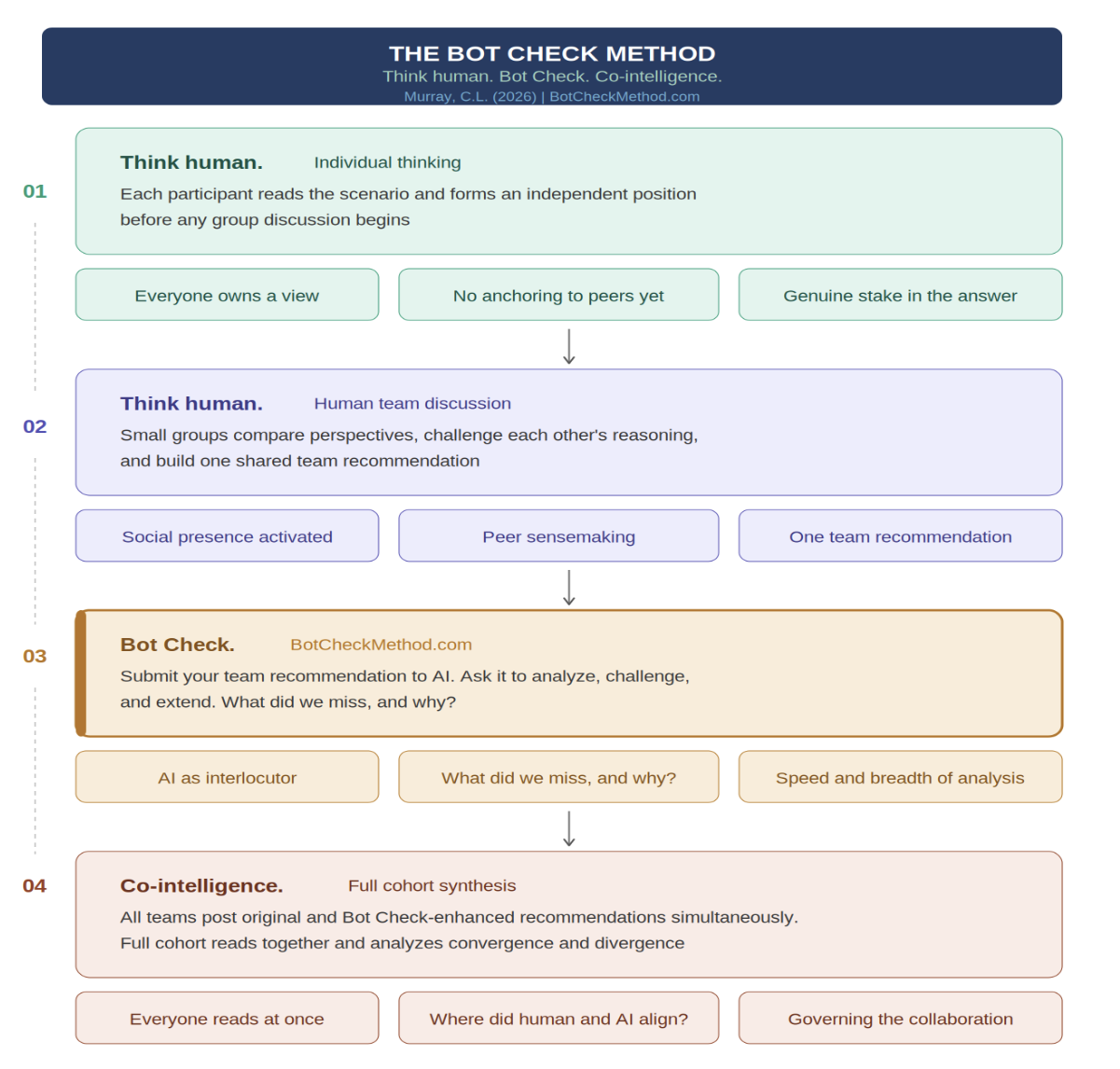
Phase 1: Think human. Before any group interaction or AI consultation, participants work through the problem alone and develop their own position. This phase is the triggering event in Garrison’s terms. It creates cognitive stake. The MIT study suggests that skipping it is not a neutral time-saving decision. It is a choice to begin the learning encounter at the point where cognitive debt is most likely to accumulate.
Phase 2: Think human together. Participants move into small groups, share their individual diagnoses, challenge each other’s reasoning and build a shared recommendation. This is the exploration phase of the CoI model. Debbie Morrison, writing on the Community of Inquiry framework, is precise: Social presence “allows the learner to feel connected with an emotional and personal connection to the group in order that they can express themselves socially, and eventually cognitively.” You cannot reach cognitive depth by bypassing the social layer. The Bot Check Method protects this phase before AI ever enters the room.
Phase 3: Bot check. Once the human team has a recommendation it can defend, they run The Bot Check: Submit the recommendation to an AI tool and ask it to analyze, challenge and extend their thinking. What gaps does it identify? What perspectives did the team not reach? Where does it agree, and what does the agreement or divergence reveal about the quality of the team’s reasoning?
A practical extension of this phase: Teams can even ask the AI to help them write the prompt they will use to bot check their own work. For instance, a team might ask, “What is the sharpest, most rigorous way to challenge this recommendation if you were trying to find its weakest assumption?” before submitting their actual analysis. This does not weaken the method, it strengthens it. The team is still the one deciding what to defend and what to revise. They are simply using AI to sharpen the instrument of scrutiny itself, rather than only the output being scrutinized.
The framing of this phase is what separates co-intelligence design from both restriction and ungoverned adoption. AI enters as an interlocutor, not as an authority. The question is not “what is the answer?” but “what did we miss, and why?” The Bot Check Method is designed to produce the brain-only neural engagement documented by the MIT study as the highest-ownership cognitive state, then invite AI into a conversation with that thinking.
Phase 4: Co-intelligence. All teams post their original recommendation and the Bot Check-enhanced version to a shared channel simultaneously. Everyone reads everything at once. The full group analyzes convergence and divergence together: Where did human and AI analysis align, where did they diverge, and what does the pattern tell us about governing the collaboration going forward? What emerges belongs to the group in a way that no individual or AI-generated output could produce alone.
Timothy McCarthy’s work on discussion facilitation at Harvard describes this kind of structured encounter as a “provocation,” a design in which the facilitator sets the conditions without controlling the outcome. The Bot Check Method operates on exactly that principle.
Think human. Bot check. Co-intelligence. The facilitator designs the sequence. The participants and the AI produce the insight together.
What the SHINE framework says about scaling this
The Bot Check Method is a session-level design. Making it an organizational capability requires the governance architecture that the SHINE framework provides. Figure 2 below maps each SHINE pillar to the failure mode it addresses, the Bot Check response and the organizational condition required for that pillar to scale.
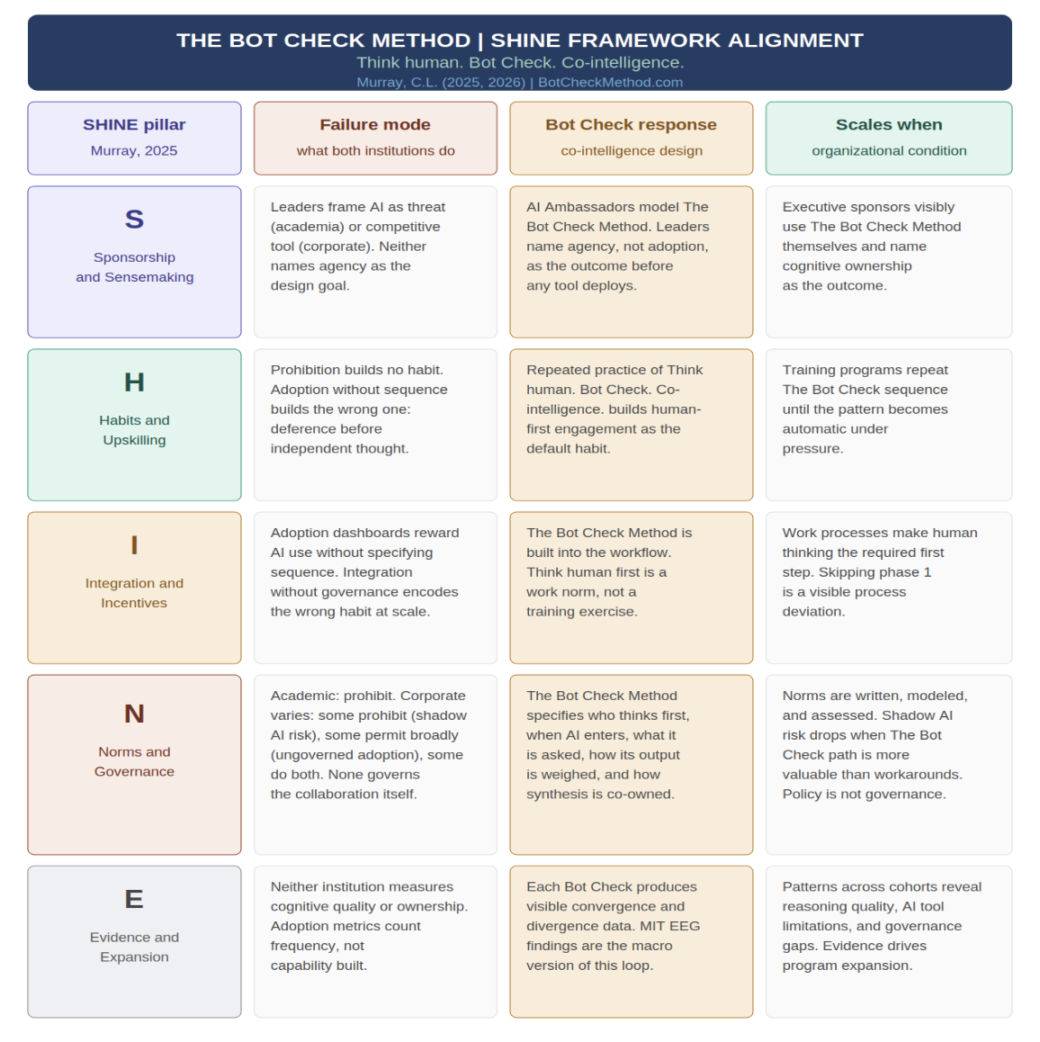
Sponsorship and Sensemaking is where the work begins. AI Ambassadors model The Bot Check Method before most people have language for it. They demonstrate what “Think human, bot check, co-intelligence” looks like in practice. That is sponsorship in the truest sense: not authorizing AI use, but modeling what purposeful AI use looks like when human agency is the design objective.
Habits and Upskilling is where the abstinence analogy lands hardest. You cannot build a healthy habit by prohibiting the behavior. And you cannot build the right habit by deploying the tool and measuring usage frequency. Every time a learner moves through “think human, bot check, co-intelligence,” they are building a behavioral pattern that over time becomes the default way they engage with AI. That is what AI upskilling should be producing in both corporate and academic contexts: not tool proficiency, but a practiced sequence of human-first, AI-informed engagement. The most advanced version of this habit is using AI to sharpen your own scrutiny of AI, asking the tool to help you build a better challenge before you ever apply it to your own thinking.
Integration and Incentives is where the corporate adoption dashboard problem is most visible. The Bot Check Method must be built into the workflow itself: Individual reflection before AI consultation is not a training exercise, it is a work norm. When the process makes “think human” the required first step before any bot check is run, the incentive structure changes. The workflow rewards agency before it rewards access.
Norms and Governance is the pillar that neither academia nor corporate America has built at the level the moment requires. Academic AI policies prohibit. Corporate AI guidelines vary: Some prohibit and produce shadow AI risk, some permit broadly and produce ungoverned adoption, some do both and produce accountability blur. What none of these produces is governance architecture for how humans and AI think together. The Bot Check Method is that architecture — named, teachable and repeatable. The critical distinction is that governance is not a usage policy. It is a design for the collaboration itself.
Evidence and Expansion is what closes the loop. Each bot check produces visible convergence and divergence data. Over time, those patterns reveal the quality of team reasoning, the limitations of the AI tools in use and the governance gaps that remain. The MIT EEG study is the macro version of exactly this evidence loop. Learning organizations that build evidence loops into their AI enablement programs will be able to answer the design question for their own contexts rather than waiting for a neuroscientist to do it for them.
A note of gratitude and context
The thinking in this article has been sharpened significantly by my participation in the Columbia University School of Professional Studies Pedagogical Lab, a 13-week faculty development program designed to equip instructors with the knowledge, skills and capabilities to design effective learning activities, teach with inclusivity and leverage AI to enhance classroom engagement.
I am grateful to the program facilitators, Conrad Fernandes and Jack McGourty, and to the program associates, Cheryl Fisher and Bhavna Sethi, who served as my group associates and whose engagement with these ideas across our cohort helped me see the corporate and academic applications with greater clarity than I would have reached alone.
What the Pedagogical Lab makes visible is that “think human, bot check, co-intelligence” is not discipline- or sector-specific. It is a principle of human learning. The same sequencing that produces agency in a graduate seminar produces agency in a corporate leadership academy. The pedagogy is portable because the human cognitive architecture it is designed to engage is universal.
The question learning leaders must now answer
The MIT Media Lab study is not an argument for restriction. It is an argument for design. What it demonstrates is that the sequence in which AI is introduced into a learning encounter has measurable consequences for neural engagement, cognitive ownership and the learner’s capacity to think independently when the tool is no longer present. Those consequences accumulate over time. The researchers call that accumulation “cognitive debt.” Learning leaders in corporate America and in the executive classroom might call it the slow erosion of the capability their programs are designed to build.
The answer is not to keep AI out. Students and employees are using it regardless of what policies say. The answer is not to get AI in as fast as possible. Speed of adoption without sequence governance produces exactly the cognitive pattern the EEG data reveals.
The answer is agency. Designed, sequenced, governed, practiced and evidenced agency. The kind that puts human thinking first, protects it through peer dialogue, runs The Bot Check at the right moment and produces co-intelligence that carries genuine intellectual ownership.
That is what The Bot Check Method produces. It is what comprehensive education produces over prohibition. It is what capability building produces over adoption metrics. And it is what the research, the pedagogy and the neuroscience are all, from different directions, now pointing toward.
The journey from abstinence to agency does not require a new platform, a new policy or a new budget line. It requires a decision about sequence, a commitment to governance and the willingness to design for the human before deploying the tool.
The question is whether learning leaders, in boardrooms and in classrooms alike, will make that decision before the cognitive debt compounds any further.