



Over the years, I have watched learning technology solve increasingly sophisticated versions of the same problem: How do we get the right learning to the right person?
We moved from catalogs to search, from search to recommendation engines, and then to adaptive learning. Artificial intelligence has accelerated that progression, making it easier to recommend courses, generate content, tailor assessments and analyze learner behavior.
Yet in recent conversations with learning and development leaders, another question keeps surfacing: How do we know someone is ready to perform? AI can recommend what people should learn next, but organizations ultimately need evidence that people can apply in real situations.
Personalization solved only part of the problem
Personalization has traditionally focused on content. A system identifies a learner’s interests or skill gaps, then recommends the next course. This improves relevance and reduces the burden of finding content. But relevance does not equal readiness. Completing a course tells us that someone completed a learning activity. It tells us much less about how well they can apply the skill at work.
The distinction becomes clearer when we look at what readiness requires. There are three distinct questions inside personalized learning:
- Knowledge: Does the learner understand what to do?
- Practice: Can the learner apply it in a realistic but safe environment?
- Performance: Can the learner apply it when the real situation arrives?
Much of what we call personalized learning has concentrated on knowledge and content pathways. AI gives us a way to connect knowledge with practice and performance.
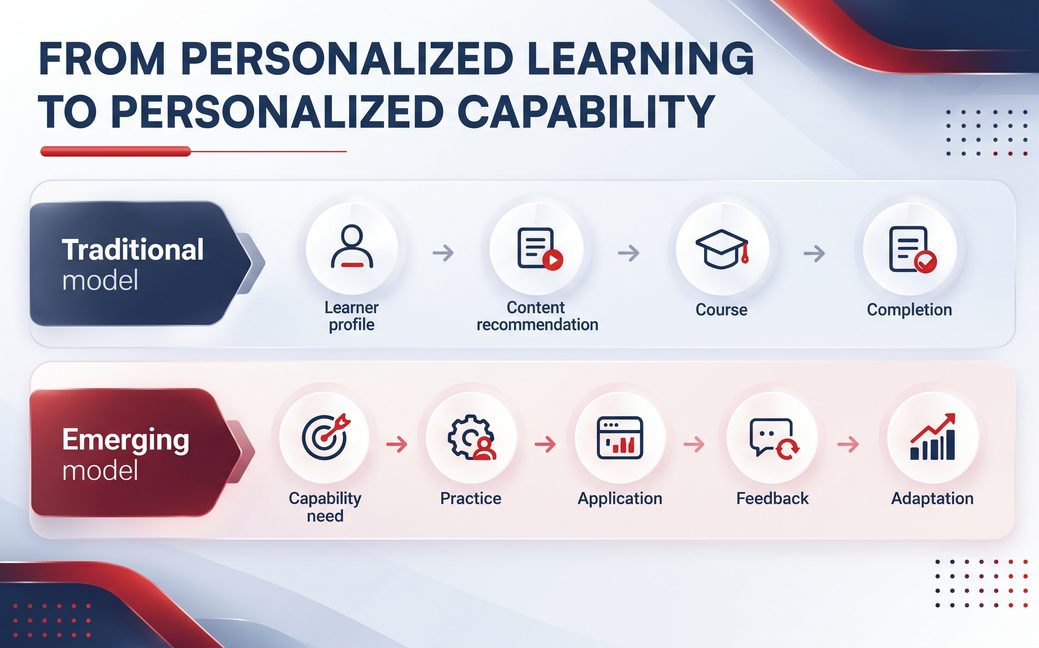
The first model personalizes consumption. The second personalizes development. For organizations, the bigger question is whether that personalization leads to demonstrated performance. That changes what personalization should optimize for.
Practice may be the next frontier of personalization
A course recommendation starts with the question, “What should this person learn next?” Capability development starts further upstream: “What does this person need to perform better?”
Answering this requires richer signals: current proficiency, role expectations, performance gaps, work context, prior experience and signals generated through everyday work. That also changes what we personalize. Instead of personalizing around courses, we can focus on capabilities such as negotiation, decision-making or using emerging technology effectively.
I saw this distinction recently in a conversation with a professional certification organization. We started by talking about improving learning content. The conversation quickly moved to a harder question: How do we help candidates identify what they still need to practice?
More content was not the answer. They needed a way to diagnose gaps, practice against those gaps, receive feedback and build confidence before the assessment.
A similar pattern comes up in leadership development. Knowing the principles of a difficult conversation is very different from navigating one. An AI-enabled practice environment can let a manager rehearse that conversation, respond to an employee who reacts unexpectedly and receive feedback on what happened.
In that setting, personalization could mean knowing what to practice next rather than simply receiving another module recommendation.
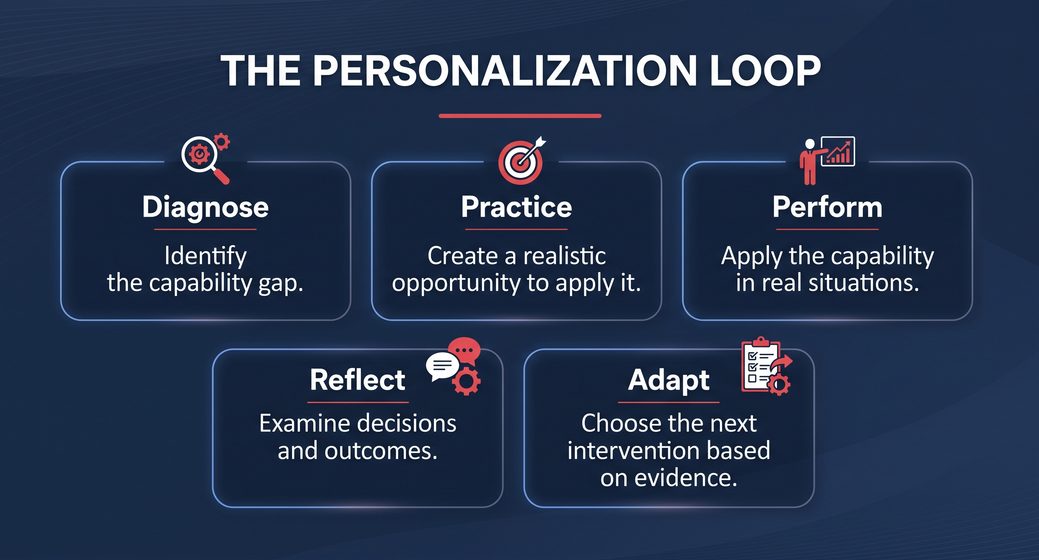
If the aim is stronger performance, people need opportunities to practice the skills they are expected to use. Development becomes an ongoing process: people practice a skill, apply it, receive feedback, improve and practice again.
AI can make this process easier to scale. Managers, coaches and subject-matter experts still play an important role, however. They provide judgment, accountability and developmental relationships that technology cannot fully replicate.
AI can also support different parts of the process in different ways. During practice, it can adjust the scenario, complexity and context. During performance, it can provide contextual support where appropriate. Afterward, it can analyze decisions and help determine whether someone needs more learning, practice, coaching, or real-world application.
Some capabilities simply require more than explanation. Judgment, negotiation, coaching and decision-making develop through making choices, seeing consequences and adjusting. That is why practice becomes so important.
There is another implication worth considering.
Sometimes the best personalized learning decision may be no learning intervention at all. If someone can already demonstrate the capability, the system should recognize that and get out of the way. An opportunity to apply the capability may be more useful than another course.
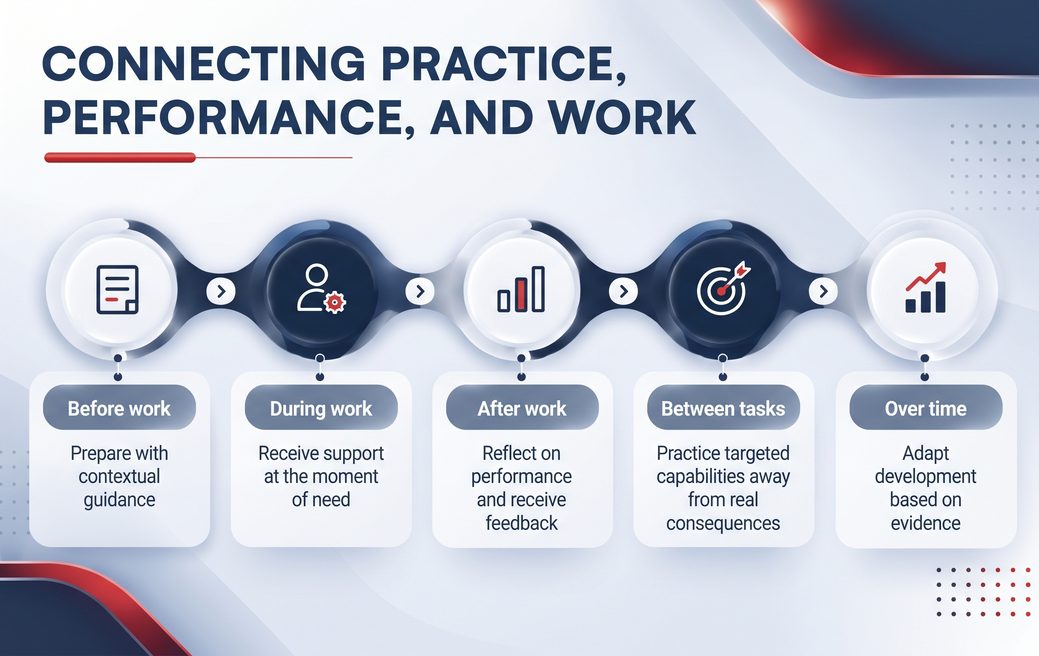
Practice across the learning and work cycle
Practice does not always need to happen while someone is working. “Learning in the flow of work” has become familiar language, but some skills need deliberate practice before people face real consequences.
A technician should not encounter a safety-critical procedure for the first time during an incident. A customer-facing employee should not have to figure out a difficult situation with a real customer. A new manager should not practice a high-stakes performance conversation for the first time with an employee.
People can prepare before the moment, receive support when they need it and reflect afterward. They can then use what happened to guide their next round of practice.
The broader technology environment is moving in the same direction.
Gartner projected that 40 percent of enterprise applications would include task-specific AI agents by the end of 2026, up from less than 5 percent in 2025. More recent Gartner research suggests that much of the tangible value from agentic AI may come from specialized, domain-specific agents rather than general-purpose ones.
For L&D leaders, the implication is clear: context matters. Generic AI layered over generic content is unlikely to address the specific judgment, knowledge and performance requirements of every role.
Make readiness measurable
That leaves a practical question for L&D leaders: How do we know development is working?
For decades, L&D leaders have relied on completion rates, engagement and learning hours. Completion rates, engagement and learning hours still tell us something. They just do not tell us whether someone can apply what they learned at work.
Part of the difficulty is that we often blur capability evidence with capability indicators. Confidence, for example, can tell us how prepared someone feels. It does not prove that they can perform. Someone can feel prepared and still struggle when the situation changes.
A stronger picture of readiness comes from several forms of evidence: demonstrated proficiency in practice, quality of application in real work, manager or expert observation, consistency over time and, where appropriate, confidence.
No single signal proves capability.
Looking at these signals together gives L&D leaders a fuller picture than course completion alone. They can show whether development is translating into performance and where people need more practice. They can also reveal when the problem lies in the work itself rather than in the individual. This does not mean instrumenting every action an employee takes. Capability measurement needs boundaries. The aim is to gather enough meaningful evidence to support development, not to turn everyday work into continuous surveillance.
What this means for CLOs
This broader view of development gives chief learning officers a different set of questions to take to the business. I would start with three decisions:
First, define what capability actually looks like. Before adding AI to learning, determine with the business on what good performance means. Make the expected behaviors observable.
Second, decide where practice belongs. Not every capability needs a simulation. Some may call for coaching, observation or real-work feedback. The question is: What experience will actually help someone develop the capability and what evidence will tell us whether it worked?
Third, decide what evidence you will trust. Clicks and completions are easy to capture. Capability signals are harder. They require thoughtful governance and agreement about what counts as meaningful evidence.
CLOs are well positioned to lead this conversation because they understand how people build skills and change behavior. As organizations redesign work around AI, that perspective connects learning, talent, technology and business strategy, making capability development a workforce priority.
Personalization is not the destination, capability is
Personalized learning still matters. People should not have to navigate irrelevant content or sit through development they do not need. But relevance is only the starting point.
AI can help L&D teams understand what someone can already do and where they need more development. It can create a safe place to practice, provide support when they apply the skill and capture useful feedback afterward.
For years, our industry has asked how to get the right learning to the right person at the right time. The next era of AI-enabled development will be defined by a different goal: helping the right person demonstrate the right capability at the right moment.