


Consider this chief learning officer’s charge: A team is asked to roll out a copilot using artificial intelligence across three business units, build an enablement curriculum, certify every manager and track completion rates on an interactive learning and development dashboard.
On paper, every box is checked. But 18 months in, usage is divided: A handful of teams have integrated the tool into their workflow, rewriting how they draft, review and hand off work, and have become measurably sharper and faster through their learning. Meanwhile, other teams still cling to existing ways of working, with the copilot open yet unclicked, treating the rollout as another mandate to wait out.
The most valuable detail is one no dashboard can reveal: The adopters didn’t share what they’d learned. The teams that opted out didn’t reveal their struggles. Both silences ran on the same logic.
Admitting “I don’t know what I’m doing with this yet” felt like exposure, a confession of falling behind, and surfacing a workaround carried the calculated risk of “going rogue.” By the time the CLO scheduled a refresher, the tool had evolved again, and whatever either camp learned in the meantime had nowhere to go.
The issue wasn’t adoption. It was circulation. Without this step, learning cannot move through the organization quickly enough to keep pace with technological adoption.
The problem has both widened and deepened. Organizations are moving to roughly double AI investment as a share of revenue, with 72 percent of CEOs now personally directing AI strategy. Capability requirements are shifting at the pace of leadership attention, not curriculum cycles.
Deloitte’s Global Human Capital Trends finds seven in 10 business leaders name speed and organizational nimbleness as their top competitive strategy through 2029, yet 59 percent of organizations still take a purely tech-focused approach to AI. Moreover, those organizations are 1.6x more likely to fall short of the returns they expected compared with organizations infusing the technology with human-centered design.
In an AI rollout, this means designing for trust, judgment and psychological safety alongside functionality. People closest to the work need space to adopt, question and improve the tool rather than simply comply with it.
Udemy’s 2026 Global Learning and Skills Trends Report captures this gap at the employee level: A vast majority (88 percent) say effective leadership is critical to their organization’s AI initiatives succeeding, but a minority (48 percent) believe their own managers are AI-ready.
The reinforcement L&D depends on most is, by employees’ own account, the least prepared link in the chain, and the least psychologically safe to admit it. The central design question for L&D leaders now isn’t what to teach about AI; it’s how knowledge needs to move, and how to establish and sustain human-centered networks of trust and learning for that movement to happen at a pace of restructuring no pre-set curriculum can match.
From cascade to circulation
The old architecture assumed a cascade: knowledge designed at the top, pushed downward, unidirectional and reinforced at intervals (if at all). Feedback, when present, often arrived too late to matter (often in a survey post-rollout, thinly processed or broadly discussed). Adaptive leaders point to a structural fix: return the work to the people closest to it.
A deeper version of this same structural fix was coined decades earlier. Single-loop learning corrects an error without examining the assumption that produced it, while double-loop learning goes further and questions the governing assumption itself. A cascade is a single-loop system by design. It can adjust an output, but it cannot touch the logic beneath it. Meanwhile, a circulation is double-loop learning at scale. The frontline isn’t the last stop; it’s a source.
In adaptive leadership, a systems mindset prioritizes relatedness and multidirectional loops over top-down cause and effect. Both relational and mechanistic, multidirectional loops carry real signal only if people believe two things: that what they say will change something, and that saying something won’t be used against them. A systems mindset holds the leadership-identity question and workflow-design proposition at once.
Circulation runs on trust, not tooling
When AI gets treated through the lens of adoption—a tool around which to capture and understand use and a platform around which to shape policy—key insights get lost. Adoption stays in the shadows, struggling teams stay quiet, competence is questioned, dispensability is feared and being perceived as behind is felt. The emotional labor of admitting confusion or of standing quietly ahead of the curve is unsanctioned.
A humanizing mindset means attending to people, purpose and presence, not just process. It makes the sensing infrastructure usable; a leader modeling their own not-knowing, in real time, sets the norm for anyone else.
We’ve seen this work in practice through rapid-cycle inquiry: short, structured bursts of authentic listening (flash focus groups, brief workflow walk-throughs) that feed directly into an active decision. One organization built a single question into its leadership meetings: What are we assuming about this tool that we haven’t tested? Within two quarters, that question surfaced a workaround one regional team had quietly built on its own.
What made this ritual work was timing: A senior leader asked the question of themselves first, before asking anyone else to answer it, an inquiry mindset made visible. This requires organization-level adaptive intelligence: the collective capacity to sense a live signal, question the assumption behind it and act on findings in the moment, rather than waiting for a formal review cycle to authorize the response. Adaptive intelligence is what turns a single rapid-cycle inquiry into a durable habit.
Whose knowledge gets to circulate?
A circulatory model built without equity in mind just re-concentrates power under a new name. Those most likely to have their AI experimentation noticed, credited and aligned to strategy are those already closest to power: visible, credentialed, fluent, at the table.
Meanwhile, those further from institutional decision-making go structurally unsupported. As a result, their knowledge is most likely to fade rather than circulate. It’s not because it’s less valuable, but because there is no channel to harness it.
Applying a humanizing mindset builds learning systems that extend beyond traditional power structures. It builds psychological safety into the system so people across levels and identifies can share knowledge without fear of being dismissed or diminished.
“Applying a humanizing mindset builds learning systems that extend beyond traditional power structures. It builds psychological safety into the system so people across levels and identifies can share knowledge without fear of being dismissed or diminished.”
Turn the tool into a listening partner
The same AI reshaping the nature of work can also transform how an organization learns from itself. Agentic AI can now recognize patterns, predict trends and automate detection of divergence from, and adaptation to, standard practice. A handful of organizations are beginning to use this capability as an early-warning system during rapid-cycle inquiry work: AI flags four unconnected teams with independently unique use cases with a human remaining in the role of ultimate decision-maker as to what, if anything, gets built around it.
Used this way, AI becomes a critical organ of the circulatory system: a listening and learning partner at a scale no L&D team could realistically staff for. This only works, though, if it’s introduced the same way any other high-trust listening mechanism is introduced: named publicly, opted into rather than imposed and never used to individually surface who is “behind.” The moment a sensing tool feels like surveillance, the candor it depends on disappears. While technology can extend the reach of an inquiry mindset, it cannot substitute for the trust people need to feel in its presence.
Judgment becomes the real curriculum
AI-era L&D runs into a paradox: the tool itself increasingly teaches the “how.” Ask AI to draft a financial model or a communications plan, and it will, within a given (trained-on) workflow. That’s what BCG frames as “a gift” to a field that has spent decades trying to move training closer to the moment of need. Once a tool can teach the procedure on demand, L&D no longer has to teach the procedure. Judgment becomes the new curriculum: when to trust an output, when to interrogate it and what to do when a confident answer is inaccurate or encodes bias nobody would defend out loud.
We’ve argued for years that so-called soft skills are the true “power” skills, that reflexivity and the capacity to sit with ambiguity aren’t adjacent to technical competence but are load-bearing skills for individuals and teams. AI has only reinforced this.
Redesigning potential around teams
Potential used to mean what an individual could be trained to do. Today’s question is different: how quickly can a team recombine complementary human and machine capability around the demands of a project? We’ve used trait- and skill-mapping with clients where, instead of screening a person against a fixed job description, we’ve mapped specific strengths (future focus, idea generation, execution, interpersonal sensitivity) to an active project. Around that map, the team is designed, and AI is embedded.
With a systems mindset applied at the team level, the team is treated as reconfigurable, with limited permanence, choosing to assemble around the work rather than according to the org chart. This is only possible when a humanizing mindset frames reconfiguration as growth rather than exposure. Otherwise, the very act of regrouping around strong actors becomes one more thing that weakens the team.
Today’s version of that rollout
Picture this: A senior leader opens the pilot rollout by admitting, in front of the room, that she still fumbles half her own prompts. A simple question becomes a fixture across standing team meetings: How did the tool surprise you this week?
Within a month, the team’s workaround isn’t a rumor anyone has to dig for. It’s already been embedded into three more teams’ work. Turns out, saying “I found this, but I don’t fully understand why it works yet,” is the most respected thing anyone can say in that room.
Eighteen months in, the tool has evolved twice, but so has the curriculum, dynamically in step. Successfully building this habit creates the distinction between an organization that circulates what it knows and one that cascades.
What this looks like in the next two quarters
None of this requires a platform migration, but it does require deliberate learning design choices. Pick one current or near-term initiative and build a standing listening mechanism into its pre-launch, where possible: a standing five-minute inquiry slot with the managers and frontline teams who will use it, tracked for a full quarter. Have a senior leader model naming their own uncertainty about the tool first, in that same room, before asking others to contribute.
Next, purposefully widen the reach of the sensing mechanism (where possible, include contract staff, frontline and night-shift teams and people least likely to be in the room by default) and treat what surfaces as a design input.
Simultaneously, run a trait-mapping exercise against the actual work rather than the org chart, newly identifying and leveraging strengths previously invisible because no one had mapped or surfaced them.
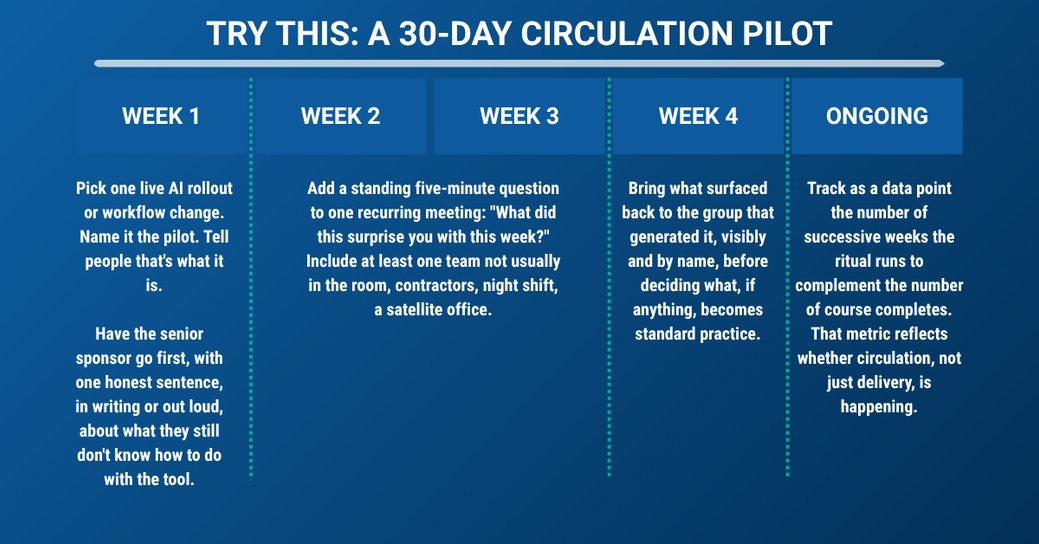
None of this is a one-time initiative. The deeper task is to build the organizational habit of continually inspecting whether your system is at competitive speed and carries the commensurate trust of today’s world.
In a period defined by volatility and constant change, leaders cannot simply respond to the disruptions that systems fail to absorb. Instead, they must become designers of systems that produce connection, resilience and continuous learning.
A CLO who treats learning circulation as core infrastructure—not a change-management response—is already doing that design work. The role moves from curriculum owner to learning architect the moment that capacity becomes existential. AI has opened a portal for organizational learning, but it only works if people feel safe to share, say or show what they do and do not know.
In the organizations that get this right, people tap into and bring what they’re learning back around. This is the ultimate competitive advantage.