



Leadership has never been more complex. Organizations are navigating rapid technological change, workforce disruption, economic uncertainty and shifting employee expectations. Amid these challenges, leaders are often continuously searching for solutions to increasingly complicated problems.
Yet when I coach executives, teach leadership development programs or work with teams experiencing conflict and change, I find that many leadership challenges stem from something surprisingly simple: Leaders have neglected one of the essential responsibilities of leadership.
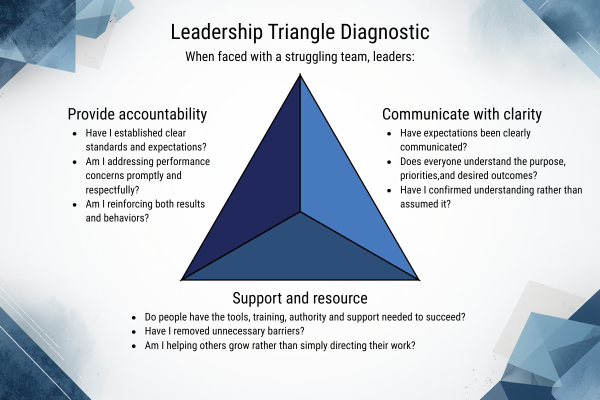
Over time, I have come to rely on a practical framework, which I learned from Dr. Justin Irving, that I call the leadership triangle. It consists of the three competencies that every leader must consistently demonstrate:
- Communicate with clarity
- Support and resource
- Provide accountability
While these competencies may seem straightforward, their consistent application is often what separates effective leaders from ineffective leaders. More importantly, they provide chief learning officers, talent management professionals and people leaders with a practical framework for developing leaders who can successfully navigate complexity, build trust and improve team performance.
The leadership triangle serves as both a leadership model and a diagnostic tool. When teams are struggling, conflict is increasing or performance is declining, leaders can often trace the issue back to one side of the triangle that has been neglected.
Communicate with clarity
The first responsibility of leadership is creating clarity through successful communication.
Employees cannot align themselves with expectations they do not understand. They cannot contribute effectively to priorities that have not been clearly articulated. And they cannot make sound decisions when information is inconsistent or incomplete.
Research consistently reveals how uncertainty creates anxiety, reduces engagement and impairs performance. Yet many leaders assume they have communicated clearly simply because they have spoken.
Communication is not measured by what is said. It is measured by what is understood. Clear communication helps people answer fundamental questions:
- What are we trying to accomplish?
- Why does it matter?
- What role do I play?
- What does success look like?
- How will decisions be made?
In leadership development programs, I often ask participants to reflect on a time when they felt frustrated by a leader. Many describe situations involving poor communication: unclear expectations, shifting priorities, conflicting messages or a lack of transparency during change.
The challenge is that leaders frequently overestimate the clarity of their communication. What feels repetitive to leaders can often feel insufficient to employees.
For CLOs, this presents a vital development opportunity. Communication is a leadership discipline that includes expectation setting, active listening, feedback, storytelling and creating shared understanding. Organizations that intentionally develop these capabilities will create leaders who are better equipped to align teams, lead change initiatives and foster engagement.
When leaders communicate with clarity, they reduce ambiguity and create alignment. When they fail to do so, confusion quickly fills the gap.
Support and resource
Alone, clarity is insufficient.
Once expectations have been established with clear communication, leaders must ensure that people have the support and resources necessary to succeed.
This competency aligns closely with the work of Dr. Irving, whose research highlights the leader’s responsibility to support and resource followers. Irving argues that effective leaders recognize their role is not simply to direct performance but to create the conditions that enable others to thrive.
This perspective reflects a growing body of leadership research suggesting that long-term organizational success is often determined less by what leaders accomplish personally and more by what they enable others to accomplish collectively. Unfortunately, many organizations unintentionally promote leaders who excel at setting expectations but struggle to remove obstacles.
Employees hear messages such as:
- “Be innovative.”
- “Increase collaboration.”
- “Improve performance.”
- “Deliver results.”
Yet they are often given little guidance, support, time, training or authority to accomplish these objectives. The result is predictable: frustration, disengagement and burnout.
Support and resourcing can take many forms:
- Providing necessary tools and technology.
- Offering training and development opportunities.
- Removing organizational barriers.
- Clarifying decision-making authority.
- Coaching employees through challenges.
- Creating psychological safety for learning and experimentation.
For CLOs and talent management leaders, this competency is particularly significant. Leadership development should not focus exclusively on helping leaders improve themselves. It should also help leaders become more effective developers of others.
One of the most powerful mindset shifts leaders can make is moving from asking, “How do I get better results?” to asking, “How do I help my people succeed?”
This shift reflects a central principle found in servant leadership literature. Great leaders view their success as inseparable from the growth and success of those they lead.
When leaders effectively support and resource their teams, they create environments where people can contribute, learn and thrive.
Provide accountability
The third side of the triangle is often the most uncomfortable.
Many leaders communicate expectations and genuinely care about supporting their people. Yet they hesitate when it comes to providing accountability. They avoid difficult conversations. They delay performance discussions. They hope problems will resolve themselves. Unfortunately, they rarely do.
Accountability is not about punishment. It is about stewardship.
Effective accountability helps individuals understand whether their behaviors and performance align with agreed-upon expectations. It provides feedback, reinforces standards and promotes growth.
When accountability is absent, several problems emerge:
- High-performers become frustrated.
- Standards begin to decline.
- Trust erodes.
- Team morale suffers.
- Leaders lose credibility.
Ironically, avoiding accountability often creates the very conflict leaders are trying to prevent.
Accountability should not be viewed as the opposite of support. In healthy leadership systems, support and accountability work together. Leaders provide the resources necessary for success and then hold individuals responsible for applying them effectively.
This balance is particularly important in leadership development. Organizations often emphasize empathy, coaching and relationship-building, which are essential leadership skills. However, these skills become incomplete when leaders lack the courage to address performance concerns directly.
The most effective leaders demonstrate both care and candor. They challenge people because they believe in their potential.
Accountability, when practiced well, becomes an act of respect.
From leadership competency to leadership system
One reason the leadership triangle resonates with CLOs is that it extends beyond individual leader behavior and can be embedded throughout an organization’s talent systems.
Consider how frequently organizations develop leaders in one area while unintentionally neglecting another. Leadership programs may emphasize communication skills but provide little training on coaching and resourcing others. Performance management systems may focus heavily on accountability while failing to equip leaders with the tools needed to support employee success. Succession planning discussions often evaluate results while overlooking how those results were achieved.
The leadership triangle offers a common language that can be integrated across leadership selection, onboarding, coaching, performance management, succession planning, and leadership development initiatives.
Imagine leaders throughout an organization evaluating their effectiveness through the same lens:
- Am I communicating with clarity?
- Am I providing the support and resources necessary for success?
- Am I holding people accountable to agreed-upon expectations?
When these questions become part of the organization’s leadership culture, leadership development shifts from a collection of isolated programs to a coherent system.
Why the triangle matters
What makes the leadership triangle particularly useful is that it functions as both a development framework and a leadership checklist.
When leaders encounter challenges, they can pause and ask three simple questions:
- Have I communicated with clarity?
- Have I provided support and resources?
- Have I established and maintained accountability?
In my experience, most leadership failures occur because one side of the triangle has been neglected. Sometimes, leaders hold people accountable for expectations that were never clearly communicated. Sometimes, leaders establish ambitious goals but fail to provide the resources necessary for success. Sometimes, leaders communicate effectively and offer extensive support but never address underperformance.
The triangle reminds us that leadership effectiveness is rarely found in any single competency. It emerges from balancing all three.
As organizations continue to face increasing complexity, leaders will inevitably encounter difficult decisions, challenging conversations and periods of significant change. In those moments, the most effective response may not be finding a new leadership technique.
It may simply be returning to the fundamentals.