



Artificial intelligence is reshaping work faster than most organizations can absorb. Chief learning officers, learning and development leaders and HR partners face relentless pressure to upskill their workforce, deploy AI-enabled tools and demonstrate measurable business impact. Yet many of the people they serve report feeling overwhelmed, uncertain and exhausted by the pace of change.
This tension has produced what many organizations now experience as AI fatigue. Crucially, employees are not resisting AI itself. They are fatigued by unclear expectations, constant tool churn and learning strategies that prioritize adoption speed over human readiness. The signal is important: The problem is not technology. It is the design of how learning is delivered.
AI fusion skills offer a way forward. By shifting learning from tool mastery to human judgment and agency, fusion skills help organizations reduce overwhelm while building the kind of durable capability that survives the next wave of disruption.
The making of an AI fatigue crisis
AI fatigue is rooted in a dynamic that L&D leaders will recognize immediately: Technology adoption is outpacing the human systems of learning and support built to sustain it.
The evidence is striking. Research from The Upwork Research Institute, drawing on a survey of 2,500 global workers, including C-suite executives and full-time employees, found that while 96 percent of C-suite leaders expect AI to boost worker productivity, 77 percent of employees report that AI tools have increased their workload. Nearly half of those employees—47 percent—said they have no idea how to achieve the productivity gains their employers expect. The result: 71 percent of full-time employees surveyed reported experiencing burnout.
This aligns with two decades of research on technostress—the psychological strain that individuals experience from the demands of using information systems. Tarafdar, Cooper and Stich demonstrate that rapid technological change increases burnout when job demands rise faster than autonomy, clarity, and skill development. In that environment, asking employees to “experiment” with AI without structure or support does not accelerate innovation. It accelerates fatigue.
There is also a confidence gap compounding the problem. Executives adopt AI tools at significantly higher rates than frontline employees, creating a widening disparity between the enthusiasm at the top and the reality on the ground. L&D leaders are being asked to close a gap that is, in part, being created by the very adoption pressure they are under.
What are AI fusion skills?
The concept of fusion skills originates in research by Paul R. Daugherty and H. James Wilson, both senior leaders at Accenture with deep expertise in human-machine collaboration. In their Harvard Business Review article, “Embracing Gen AI at Work (2024),” they define fusion skills as the human capabilities required to work effectively with generative AI—emphasizing judgment, problem framing and accountability over technical proficiency alone.
Daugherty and Wilson identify three core fusion skills that distinguish effective AI collaboration from surface-level adoption:
- Intelligent interrogation: Framing purposeful, well-scoped prompts and instructions that guide AI toward more accurate, useful and trustworthy outputs. This includes techniques such as breaking complex tasks into steps, providing rich context and specifying constraints.
- Judgment integration: Incorporating expert and ethical human discernment to evaluate AI-generated content. This means augmenting AI outputs with authoritative domain knowledge, identifying and correcting biases, and maintaining accountability for final decisions.
- Reciprocal apprenticing: Engaging in iterative, bidirectional learning with AI tools over time—training models to better understand organizational context while simultaneously deepening one’s own fluency through hands-on practice embedded in actual work.
Together, these three capabilities reframe AI from a productivity shortcut into a thinking partner that amplifies human expertise. The distinction matters enormously for learning design: developing fusion skills is not primarily about teaching people to use software. It is about cultivating the judgment to know when to trust AI, how to improve its outputs and when human expertise must take precedence.
Why fusion skills directly reduce AI fatigue
AI fatigue is driven less by technology than by two underlying dynamics: loss of agency and absence of clarity. Fusion skills are specifically designed to restore both.
They restore a sense of control. When employees understand how to frame tasks, evaluate AI outputs and retain decision-making authority, AI becomes a resource rather than a source of anxiety or obsolescence. Research consistently shows that autonomy and perceived competence reduce burnout and increase engagement in technology-rich environments. Fusion skills are not about making AI less powerful. They are about empowering humans alongside it.
They anchor learning to real work. Fusion skills are practiced in authentic tasks, not abstract training exercises. Research from Harvard Business Publishing Corporate Learning and Degreed, based on a global survey of 2,739 employees, found that AI-fluent individuals differentiate themselves through experimentation embedded in their daily workflow—they are twice as likely to report learning about generative AI through hands-on experimentation compared to their less-fluent peers. Contextual, practice-based learning is precisely what durable skill development requires.
Employees can then reframe AI as augmentation, not replacement. Fear of obsolescence is one of the most powerful accelerants of AI fatigue. Fusion skills actively counter this by positioning AI as a collaborator that enhances judgment and creativity—building career resilience rather than threatening it. This reframe is not spin. It is a pedagogically grounded shift in how employees understand their own role in the human-AI relationship.
What learning leaders can do now
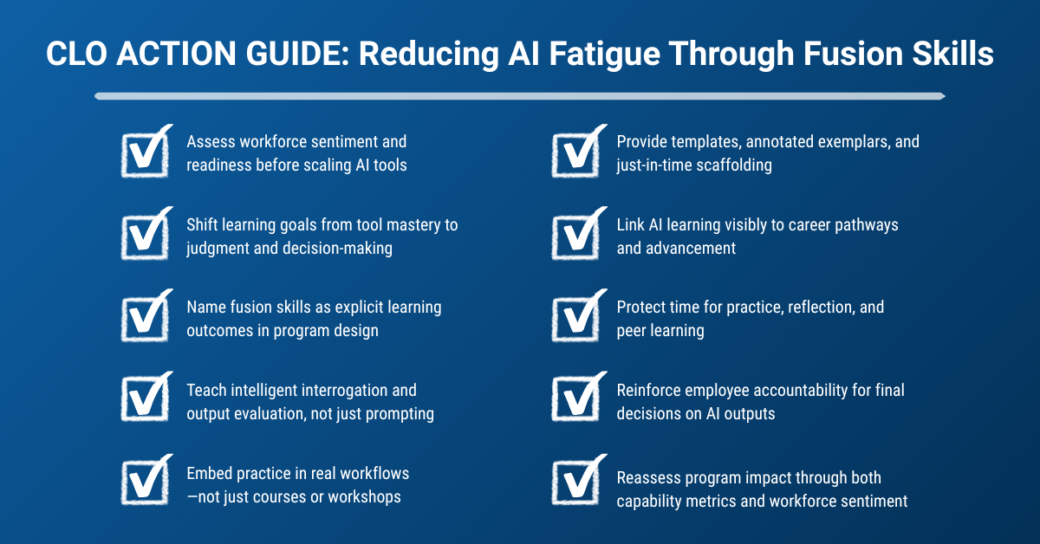
For CLOs and L&D leaders, reducing AI fatigue does not require slowing adoption. It requires intentional redesign of how learning works. The following strategic priorities are grounded in current research and practice.
Assess workforce sentiment before scaling tools. Before deploying the next AI capability, invest in understanding employee confidence, concerns, and readiness. SHRM’s analysis of enterprise AI adoption found that tailoring adoption strategies to workforce needs—rather than applying a single top-down approach—significantly reduces resistance and fatigue. A short pulse survey or focus group cohort can reveal gaps between leadership expectations and employee experience that, unaddressed, become adoption liabilities.
Make fusion skills explicit learning outcomes. Move beyond tool training. Design programs with named assessable outcomes in intelligent interrogation, judgment integration, and reciprocal apprenticing. When employees can see that the program is building transferable judgment, not just fluency with a tool that may be replaced in 18 months, engagement increases and the learning feels worth their time.
Embed learning in the workflow. Create structured space for experimentation within actual work: learning labs, AI-assisted project sprints, peer critique of AI outputs and coached practice on real tasks. The Harvard Business Publishing Corporate Learning research found that lack of organizational support—not lack of employee motivation—is the primary barrier to scaling AI fluency. Most workers want to learn. They need time, guidance and permission.
Connect AI learning to career pathways. Employees are significantly less fatigued when learning is clearly linked to advancement. Frame fusion skills not as compliance requirements but as durable professional capabilities—ones that will remain valuable even as specific AI tools evolve. Show employees that developing these skills opens opportunities, and the motivation to engage deepens.
Support capacity, not just capability. AI fatigue often reflects genuine overload, not lack of skill. Learning leaders should advocate for protected time for practice and reflection, and provide practical scaffolding—prompt templates, annotated exemplars, decision frameworks and just-in-time reference guides. Reducing cognitive load during the learning phase is not handholding; it is sound instructional design.
A way forward
AI fatigue is not a failure of employees. It is a signal that learning strategies must evolve. The gap between what organizations expect from AI and what employees experience reflects a design problem—one that CLOs and L&D leaders are uniquely positioned to solve.
By investing in AI fusion skills, intelligent interrogation, judgment integration and reciprocal apprenticing, organizations can move from overwhelm to genuine fluency. They can restore confidence, clarity and agency that make AI adoption sustainable rather than exhausting.
The most resilient organizations will not be those that deploy AI the fastest. They will be the ones that invest in helping their people learn how to think, judge and decide alongside it. That is, at its core, an L&D imperative. And it belongs at the center of every CLO’s strategy.