
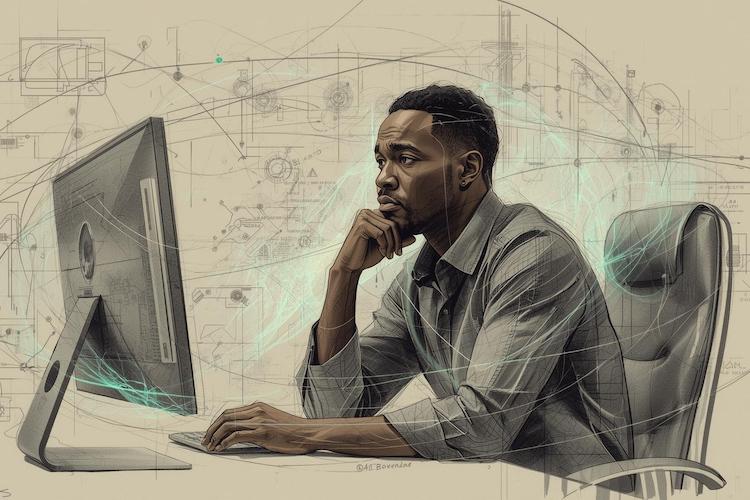
From concerns about job elimination and hiring impacts to more optimistic scenarios, one thing is clear in the age of AI: The role of the manager is changing dramatically. The most exciting part, still overlooked by many, is the tremendous upside this holds for mid- and senior-level leaders.
Too often, managers are promoted because they excel at a task — not because they’ve been trained to manage people. Add the expectation to coach teams while driving transformation, and you get the classic “player-coach” problem: Excelling at the work doesn’t always mean excelling at leading others.
With AI set to augment individual capacity and capabilities and drive the rise of the AI-powered “Superworker,” employees are more productive, higher performing and more capable of managing their own tasks — and even their AI agents. But these positive advancements come at a cost, with workers reporting record levels of fear, stress and uncertainty as they contend with the rapidly changing impact of AI on their future.
In this environment, the role of the manager is fundamentally shifting, becoming less about the need to orchestrate work and more focused on coaching, development and support — all cornerstones of more human-centric leadership.
In a future being shaped by technology, management will increasingly become a function defined by its humanity. Managers will embrace and lead with AI to supercharge their work and that of their teams, blending human and technical capabilities seamlessly for multiplicative impact.
As AI takes over task orchestration, managers will focus almost exclusively on coaching, development, well-being, skills recognition and engagement. Today, HR-style responsibilities make up only about 10 percent of a manager’s role. Soon, that share could rise to 90 percent.
AI-driven work redesign is already happening
What about managers who lack strong people skills? Do they stay in management roles or step aside? These are tough but critical questions. Since people skills are often the hardest to build, the rise of AI in daily work will force organizations to rethink hierarchies as part of broader AI-driven transformation and work and organizational redesign.
Some functions, like software engineering, will feel this acutely. Historically, it’s been challenging to find individuals who are both technically excellent and effective people managers. With AI likely to automate a significant portion of coding tasks, companies will need to rethink skill profiles and redefine management responsibilities in these areas.
Rest assured, managers will play a critical role in this AI-driven work design. As experts in the work done in their domain, they will be called on to reinvent workflows and support the overall AI transformation. They will also play a critical role in leading by example — modeling AI use and supporting their team in new ways of working.
Managers: “personalizers” of employee development
Where does HR fit into this evolving picture? As HR has become more decentralized, employee development and performance management have evolved, and employee experience has risen in priority; the line between HR work and managerial work has blurred.
For example, the management landscape has recently shifted from managers rating employee performance on an annual or semi-annual basis with HR oversight to providing continuous coaching and feedback, holding regular career development conversations and fully supporting broad development for employees.
And our data reveals that managers do have far more influence over the employee experience than HR does.
Still, a gap remains: Leadership may prioritize people’s outcomes, yet managers are still often rewarded more for business results, making it difficult to manage these shifting priorities.
Now, with AI capable of providing personalized learning and coaching, a phenomenon we term the L&D AI “revolution,” the question arises: Will it supplement or replace that role? My sense is that it will do both, making the tricky but essential work of people management easier and more effective for both managers and their teams.
Harnessing AI to address the most complex people challenges
To be precise, AI will support managers who find people management challenging. At some organizations we track in early AI adoption, employees actually prefer receiving constructive feedback from AI — it feels less personal and easier to digest.
Managers often dislike giving tough feedback, but AI can depersonalize and guide the process, providing tactical guidance for thoughtful, consistent people management. AI tools provide conversation guides, performance insights and coaching tips, making the ambiguous, stressful components of management far more approachable, even for those who don’t naturally excel in handling soft-skills tasks.
What does this look like in practice? Managers often reluctantly log into Workday, SAP or Oracle after repeated reminders, viewing HR-style tasks as extra work on top of the tasks they actually enjoy or see as their primary role, namely delivering sales targets, launching products, managing budgets or running campaigns for the organization.
Now half of this work can be handled through an AI interface that understands the manager, their team and the business. Tasks can be embedded directly into everyday workflows in Teams or Slack. Instead of logging into a separate HCM platform, the manager might simply get a prompt, such as, “Write three sentences about Jim’s performance,” with suggested content grounded in the actual performance and productivity metrics of Jim. The manager can then review, validate and expand on this.
AI HR is a reality
With responsive AI HR systems emerging, text can be automatically pulled into the HCM system. They can then generate a development conversation guide, providing managers with tips, best practices and HR policies to make the interaction successful for both parties. And they can even schedule the meeting automatically.
It’s obvious to see how this will make managers more productive (as their managerial tasks are streamlined and presented to them in the flow of work); their approach to management more personalized (with better access to relevant information); and generally improve their overall management skills with a co-pilot coach next to them at all times.
In summary, the smart way to think and plan for what AI will mean for managers is this:
- AI is changing work for everyone, both individual contributors and managers.
- Much work will soon be done by mixed teams of humans and AI agents — and managers will need to manage both.
- AI will help managers’ teams do their jobs better and help them coach and manage reports.
- AI will support managers in the people-skills and soft-skills aspects of their roles, even if they don’t feel fully prepared or naturally skilled.
From a manager’s perspective, AI in the workplace may initially bring change and uncertainty. But the future will be one where, like AI-augmented junior colleagues, managers are seamlessly supported in ways that add real value — ways we can barely imagine today.
The takeaway? The way to become an AI-empowered Supermanager is to embrace the human and the technology to enable you and your team to achieve exponential outcomes.
This article was originally published by Chief Learning Officer’s sister publication, Chief Talent Officer.