



Across boardrooms and business schools, the conversation about AI has shifted from technological curiosity to organizational necessity. After personally spending a year immersed in the GAI Insights Morning AI News Show, moderating discussions at GAI World 2025 and AI Realized, and collaborating with leaders undergoing transformation, one truth has become unmistakable: AI transformation succeeds only when human transformation succeeds.
This conclusion is reinforced by McKinsey’s “The state of AI in 2025” report, which identifies the practices that clearly differentiate AI high performers from laggards. Among the strongest predictors of AI success are leadership alignment, human-in-the-loop processes, capability building, workflow redesign and iterative development cycles.
These findings align directly with the SHINE™ framework, which I’ve developed to help leaders prepare their organizations for the new era of human-AI teaming.
As organizations move toward what Salesforce calls the “Agentic Enterprise” — workplaces where humans and AI agents collaborate to generate insight, automate workflows and accelerate decision-making — the need for a human operating system becomes essential. SHINE provides this architecture by defining the conditions teams require to work effectively with intelligent systems.
AI transformation is not a technology project. It is a leadership, talent, teaming and behavior project. And the organizations that recognize this will lead the way.
Why SHINE matters in the Agentic Enterprise Era
Agentic work environments introduce a structural shift. AI is no longer a tool. It becomes a collaborator. This requires new forms of clarity, new forms of governance, new habits of work and new models of leadership.
Classic change models like Kotter, ADKAR and Lewin still give leaders a strong, proven guide for alignment, adoption and reinforcement. In fast-shifting, AI-enabled workplaces, the opportunity is to build on these foundations with approaches designed for ongoing iteration and rapid feedback loops. And while Lewin’s unfreeze, change, refreeze remains a powerful mental model, today the pace often leaves little room to “refreeze” for long. The risk is freezing too soon and getting stuck behind as the work and AI landscape keeps evolving.
The SHINE model complements and enhances these frameworks by addressing the specific dynamics that arise when humans and intelligent agents work together. It provides the behavioral infrastructure that AI transformation requires.
The SHINE framework
SHINE comprises five interconnected pillars:
S – Sponsorship & Sensemaking: Leaders create meaning, reduce ambiguity and translate AI strategy into role-level clarity.
Actions: Lead it. Explain it.
H – Habits & Upskilling: Teams build capability through practice, reinforcement and role-based learning journeys — not one-and-done training.
Actions: Practice it. Build skill.
I – Integration & Incentives: AI gets embedded into real workflows and decision points; performance systems reinforce the new ways of working.
Actions: Bake it into work. Reward it.
N – Norms & Governance: Rules of engagement define decision boundaries, validation protocols, accountability and trust.
Actions: Set it in rules people trust.
E – Evidence & Expansion: Organizations measure, iterate, sunset what fails and scale what works — based on proof, not hype.
Actions: Prove it. Scale it.
Consider the following visual, and how it can support the SHINE framework in your organization and work:
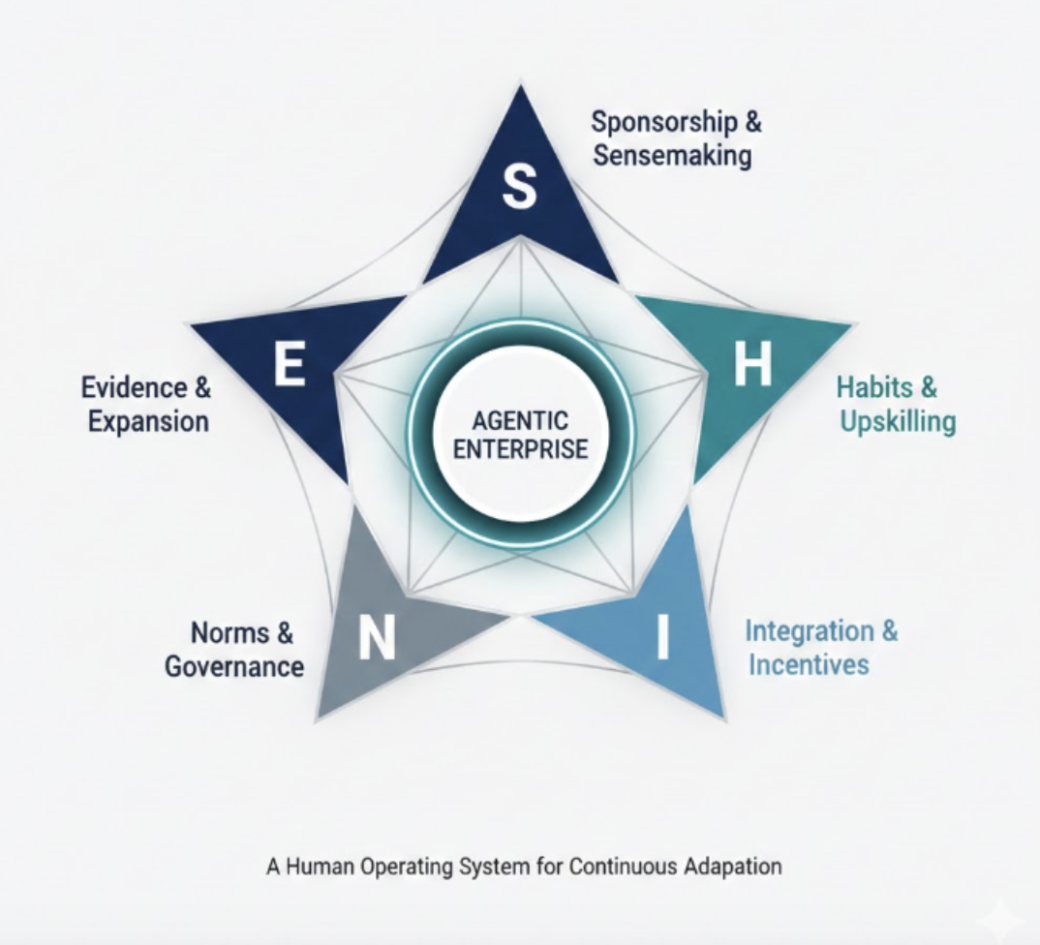
The circular core represents the “Agentic Enterprise,” where humans and AI agents collaborate.
The top S point acts as the “North Star,” representing Sponsorship & Sensemaking — the leadership clarity that reduces employee ambiguity.
The H and I points represent the “action” side of the star — building Habits and Integrating AI into the flow of work.
The N and E points represent the “stability” side — setting Norms for trust and using Evidence to scale safely.
Finally, the interconnecting lines can help visualize SHINE as a human operating system, showing that these aren’t isolated steps, but a continuous, interdependent loop.
What the research says
McKinsey’s “The state of AI in 2025” report shows that enterprise-wide EBIT impact from AI remains limited for most organizations.
McKinsey defines AI high performers as respondents who attribute 5 percent or more EBIT impact to AI and say their organization has seen “significant” value from AI use — about 6 percent of respondents to McKinsey’s global survey. These high performers are more likely to redesign workflows, scale faster and implement best practices for transformation, according to the report.
In their 2025 joint study, “Accountable Acceleration: Gen AI Fast-Tracks into the Enterprise,” Wharton Human-AI Research and GBK Collective describe 2025 as a year of “accountable acceleration.” In the study’s executive summary, they report:
- Among survey respondents, 82 percent use Gen AI at least weekly; 46 percent use it daily.
- Eighty-eight percent anticipate Gen AI budget increases in the next 12 months; 62 percent anticipate increases of 10 percent or more.
- Seventy-two percent formally measure Gen AI ROI, focusing on productivity gains and incremental profit; roughly three in four leaders see positive returns.
- “ROI is now measured, and people, not tools, set the pace.”
Together, these findings point to the same conclusion: The gap between pilots and performance at scale is the human operating system. SHINE is built to close that gap.
Each element of SHINE is grounded in behavioral science and reinforced by emerging evidence from leading research organizations.
McKinsey’s findings offer powerful validation. According to “The state of AI in 2025” report, the top differentiators of AI high performers include:
- Clear leadership alignment on AI value creation.
- Defined AI roadmaps tied to business outcomes.
- Human-in-the-loop oversight mechanisms.
- Capability building tailored by role.
- Workflow redesign to embed AI.
- Agile development cycles and rapid iteration.
- Governance structures for risk and consistency.
- Technology infrastructures that support integration.
- Scaling based on measured outcomes.
These elements align almost one-to-one with SHINE.
- S aligns with leadership clarity and strategic sensemaking.
- H aligns with role-based capability-building and iterative development.
- I aligns with workflow redesign and integration into real work.
- N aligns with human-in-the-loop governance.
- E aligns with scaling based on evidence.
This convergence is more than conceptual. It is empirical.
S – Sponsorship & Sensemaking: Leadership as meaning-maker
McKinsey notes that AI high performers are far more likely to have senior leadership aligned on AI’s value and actively creating clarity for teams. High performers also are more likely to maintain defined roadmaps that specify where and how AI will create outcomes. Leadership alignment appears as one of the strongest explanatory factors for success.
This is the heart of Sponsorship & Sensemaking.
People do not resist AI. They resist ambiguity.
Sensemaking is the act of translating uncertainty into shared understanding. It is the leadership competence that bridges the gap between aspiration and action. In the GAI Insights community, this emerges daily. Teams accelerate only after leaders create narrative clarity about what AI means for their roles, workflows and future.
Organizations that fail at AI do not fail because the technology misbehaves. They fail because leaders underestimate the interpretive load employees carry.
H – Habits & Upskilling: Building capability at the pace of change
In its state of AI report, McKinsey emphasizes that high performers excel at capability-building and create structured learning journeys that align to role expectations. They practice iterative development cycles and operate within agile rhythms that reinforce continuous adaptation.
This echoes findings in the Microsoft “AI Diffusion Report,” which shows that companies with strong learning cultures achieve up to five times higher productivity gains with AI tools.
SHINE treats habits and upskilling as behavioral disciplines. AI adoption is not a technical task. It is a habit-change process.
Employees must learn not only how to use tools, but how to integrate them into decision-making moments, not as an afterthought, but as part of the workflow.
Training without behavior change is overhead. Training with habit change is capability.
I – Integration & Incentives: Embedding AI into the flow of work
McKinsey identifies workflow redesign as a core differentiator of AI high performers. Organizations that embed AI directly into operating processes, decision pathways and customer interactions are significantly more likely to capture value. High performers also build technology architectures that support integration and create incentives that reinforce adoption.
This is the essence of Integration in the SHINE model.
Capabilities only matter when they become behaviors in context.
Salesforce’s Agentic Enterprise framing reinforces this. AI becomes most valuable when it is present at the exact moment of decision. Organizations that redesign work around AI amplify human potential. Those that bolt AI on top of old workflows create friction and frustration.
Integration requires incentive alignment. Humans change behavior when they experience meaning, reward or relief.
N – Norms & Governance: Creating the rules of human-AI collaboration
McKinsey’s state of AI report identifies human-in-the-loop mechanisms as the strongest single practice associated with high performers. High performers are significantly more likely to define when humans should validate model outputs, when they should intervene and when AI should lead. Governance around roles, responsibilities and oversight ensures that AI enhances decision-making rather than compromises it.
This aligns perfectly with the Norms & Governance pillar of SHINE.
Teams need rules of engagement with intelligent agents.
Without norms, uncertainty rises.
Without governance, risk rises.
AI does not replace human judgment. It augments it. But only when leaders intentionally design the collaboration.
E – Evidence & Expansion: Scaling what works
McKinsey notes that high performers scale AI based on evidence, not enthusiasm. They iterate, measure, refine and expand only when outcomes justify investment. They also sunset use cases that fail to produce value, reducing transformation fatigue and complexity.
This mirrors the SHINE principle that innovation must be evidence-led.
Expansion without evidence creates chaos.
Expansion with evidence creates capability.
GAI Insights discussions frequently highlight that organizations attempting to scale prematurely end up with unmanageable portfolios of disconnected tools. High performers practice disciplined experimentation.
Evidence is not an output. It is a leadership practice.
Why SHINE complements traditional change models
Kotter, ADKAR and Lewin remain foundational tools for understanding organizational change. But AI introduces a new condition: continuous adaptation. AI-era change does not have a stable end state. There is no long refreeze. The McKinsey report warns that high performers are accelerating so quickly that laggards may find it structurally difficult to catch up.
This does not invalidate traditional change models. It contextualizes them.
SHINE enhances these models by introducing:
- Sensemaking as a continuous practice.
- Upskilling as ongoing behavioral reinforcement.
- Integration as workflow redesign.
- Governance as human-AI boundary-setting.
- Evidence cycles that prevent static “freeze” periods.
In a world where models update weekly, organizations cannot freeze for too long. They must learn while moving.
Implications for leaders
AI maturity is now a leadership competency, not a technical specialization.
Talent, learning and technology leaders must operate as a unified function.
Capability-building is no longer optional. It is the performance engine.
Human-in-the-loop designs must be intentional and explicit.
Organizations cannot scale without evidence.
AI ROI depends on human readiness, not technical sophistication.
And finally, SHINE is no longer only a practical leadership model. It is now an evidence-backed framework validated by top global research.
McKinsey’s report confirms what front-line leaders across the GAI Insights community have been saying for more than a year: AI transformation is human transformation. Organizations succeed not by acquiring tools, but by creating clarity, building habits, integrating workflows, establishing governance and scaling based on evidence.
As enterprises move toward agentic AI, SHINE provides the human operating system necessary to ensure that teams, leaders and organizations are ready to thrive.