
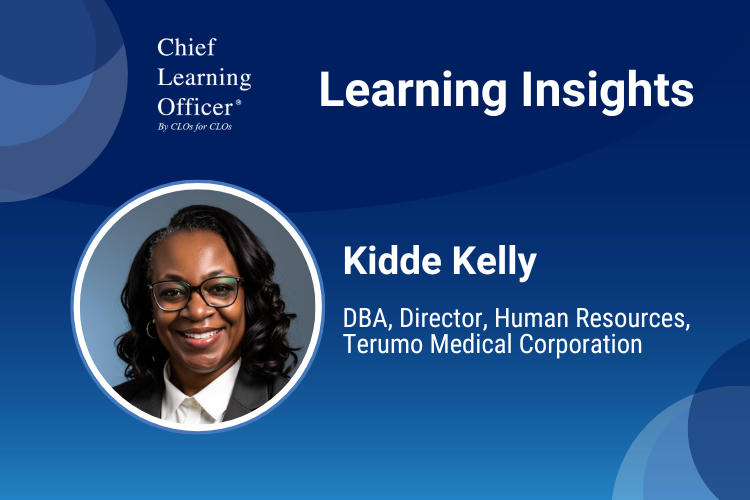
Chief Learning Officer’s “Learning Insights” series is dedicated to showcasing the thoughts and career journeys of chief learning officers and learning executives—the tireless trailblazers who are transforming the landscape of corporate learning and workforce development. In this Q&A series, we garner strategic insights, innovative approaches and challenges overcome from visionary leaders worldwide.
CLO: What initially drew you to a career in learning and development, and how have your experiences evolved over the years?
I didn’t begin my career intending to specialize in learning and development. What drew me in was a deep curiosity about why some leaders thrive while others plateau, even when they have similar technical expertise. Early in my HR and OD work, I saw firsthand that the biggest differentiator wasn’t intelligence or experience—it was a leader’s capacity to learn, adapt and include others. That realization pulled me into the world of capability building.
Over the years, my work has evolved from facilitating programs to architecting learning programs in organizations and academia. I became increasingly focused on the behaviors that accelerate or block learning—self-awareness, humility, accountability and psychological safety. Those insights ultimately shaped the foundation of the ALL IN Mentality™, which reframes leadership development as a discipline rooted in intentional behavior, not inspirational theory.
CLO: What key initiatives have you implemented as a learning leader to drive employee development and foster a learning culture?
My most impactful initiatives have centered on leader capability, culture clarity and system alignment. A few examples:
- Leadership operating rhythms that embed learning into the flow of work—weekly reflection prompts, structured team check-ins and decision-making rituals that reinforce inclusive behavior.
- Learning agility programs that help leaders navigate ambiguity with confidence and curiosity.
- People relations and HR business partner capability academies that elevate HR from transactional support to strategic partnership.
- Experience-based learning labs where leaders practice real scenarios, receive coaching and build muscle memory for inclusive leadership.
These initiatives work because they shift learning from an event to a behavioral expectation. They create a culture where learning is not optional—it’s how we operate.
CLO: What is the most impactful learning program you’ve introduced in your organization, and how has it contributed to employee growth and business success?
The most impactful program I’ve introduced is a leadership accountability and inclusion lab, which later became a core module within a dynamic leadership course for developing and future leaders. This academic integration allowed me to embed principles that informed the ALL IN Mentality™ as part of a structured, semester-long experience focused on building practical leadership acumen.
Rather than a traditional workshop, the course functioned as a behavioral immersion. Course participants engaged in targeted exercises that helped them:
- Identify their leadership patterns.
- Practice inclusive decision-making.
- Strengthen psychological safety.
- Navigate conflict with clarity and empathy.
- Translate values into consistent, observable actions.
Because it’s within a dynamic leadership curriculum, participants applied these concepts across communication, influence and systems-thinking modules—building confidence and capability over time.
The results were clear. Participants reported greater self-awareness, stronger collaboration skills and a deeper understanding of how inclusion drives performance. Faculty noted more intentional dialogue and improved leadership maturity across the cohort.
Graduates carried these behaviors back into their workplaces, contributing to higher trust, better problem-solving and more resilient teams. The program demonstrated that when emerging leaders learn to lead inclusively as a daily discipline, they accelerate both personal growth and organizational impact.
CLO: What is a common misconception people might have about the L&D function, and how do you address it?
The biggest misconception is that L&D is responsible for fixing leaders. Many assume learning teams can “train away” cultural issues or performance gaps. But L&D is not a repair shop—it’s a strategic accelerator.
I address this by reframing L&D as a capability engine, not a content provider. We partner with leaders to:
- Clarify expectations.
- Build systems that reinforce desired behaviors.
- Align learning with business strategy.
- Measure impact beyond attendance or satisfaction.
When leaders understand that L&D is a strategic lever—not a service desk—they engage differently. They become co-owners of capability building, not consumers of training.
CLO: What excites you the most about the future of workplace learning, and how are you preparing your organization to adapt to the changing landscape?
What excites me most is the shift from knowledge transfer to capability development. The future of learning is not about giving people more information—it’s about helping them apply, adapt and integrate what they know in real time.
Three trends energize me:
- Adaptive learning ecosystems that personalize development.
- Behavioral data that helps leaders understand their impact.
- Human-centered leadership models that prioritize inclusion, agility and accountability.
To prepare organizations for this future, I focus on building learning cultures, not just learning programs. That means:
- Embedding reflection and feedback into daily work.
- Equipping leaders to model vulnerability and curiosity.
- Designing systems that reward learning, not perfection.
The future belongs to organizations that treat learning as a strategic capability, not a compliance requirement.
CLO: What essential qualities or skills make a successful L&D leader, and how do you cultivate these traits in yourself and among your team?
Successful L&D leaders need a blend of strategic clarity, behavioral insight and operational discipline. The most essential qualities include:
- Learning agility—the ability to adapt quickly and stay curious
- Systems thinking—understanding how culture, structure and behavior interact
- Inclusive leadership—creating environments where people feel safe to learn
- Influence without authority—shaping outcomes through partnership and credibility
- Courage—challenging assumptions and advocating for what people need
I cultivate these traits through intentional practice. I use the ALL IN Mentality™ principles to stay grounded in awareness, accountability and intentional action. With my team, I reinforce these qualities through coaching, reflection and shared ownership of outcomes.
CLO: What game-changing advice would you offer if you could go back in time and mentor your younger self?
I would tell my younger self: “Slow down enough to see what’s really happening.” Early in my career, I equated lots of activity and speed with effectiveness. But real leadership requires presence and intentional actions, not pace.
I’d also say:
- Don’t avoid discomfort—it’s where growth happens.
- Ask better questions instead of having faster answers.
- Protect your energy the same way you protect your time.
- Select the activities with purposeful intention that will make a difference.
- Trust your instincts; they’re data too.
Most importantly: your voice matters—use it intentionally.
CLO: What do you feel is currently the single biggest challenge facing L&D professionals and the industry as a whole?
The biggest challenge is the widening gap between what organizations say they value and what their systems actually reinforce. Many companies claim to prioritize learning, inclusion and leadership development, but their structures reward speed, output and short-term results.
L&D professionals are often asked to drive transformation without the organizational alignment needed to sustain it. The challenge is not designing great programs—it’s ensuring the environment supports the behaviors those programs teach.
This is where the ALL IN Mentality™ becomes powerful. It helps leaders understand that inclusion, learning and performance are not competing priorities—they are mutually reinforcing disciplines.
Interested in being featured in our “Learning Insights” series? Please complete this FORM.