



Organizations want employees to be creative problem-solvers, yet training environments can unintentionally mimic business pressures that push learners toward rapid solutions.
This tendency undermines the ability to teach a truly necessary capability: deep, creative problem-solving. It seems paradoxical, but effectively teaching the skills to creatively problem-solve requires insulating learners from the pressure to rapidly meet business needs. At least, for a while.
Before we dive deeper into this preposterous statement, let’s start by differentiating between traditional problem-solving and creative problem-solving.
Traditional problem-solving is typically analytical and linear: You define a problem clearly and find the best answer from tried-and-true options. On the other hand, creative problem-solving is a broader approach. It asks you to reframe the problem, generate many possible responses and consider unconventional ideas.
Both approaches serve a purpose, but creative problem-solving is needed for exceptionally difficult issues.
So, can this be taught?
The “creative” in creative problem-solving is often viewed as a black-box mystery ingredient that stops people from believing they could develop this capability themselves. Sometimes, it even stops organizations from believing they could effectively increase this capability through their training efforts.
The solution lies in a strange place: play.
Not unrestricted anarchy, but the freedom to step away from business needs long enough to provide unrestricted possibility.
If this still seems unteachable, let’s get into the components necessary to deconstruct creative problem-solving and assemble them into a framework for transferring this elusive skill to your workforce. But first, we need to address a misconception of creativity.
People often use “creative” as an adjective to describe someone. The truth is that they are ascribing creativity to a person when what they are really experiencing is the emotion that the person elicited. Here is a simple example.
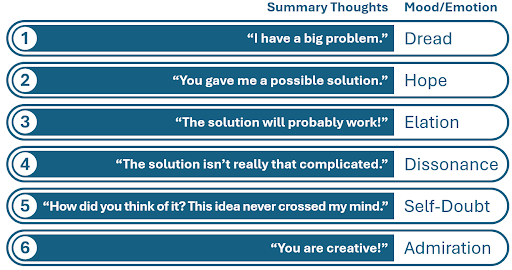
But creativity is more than an emotional impression, and problem-solving is not merely magic. They are the result of well-practiced skills. Our unintentional focus on the impact of creative problem-solving over how it is done can obscure how we approach it as a learning function.
We can teach this capability by first deconstructing it to provide actionable focus for our craft. The primary skills for creative problem-solving fall into the following categories:
- Recognition of cause vs. symptom (accurate problem definition)
- Recall of past experiences (drawing on analogous situations)
- Paradigm-floating (the ability to combine disparate concepts to generate new possibilities)
Our role as leaders is to successfully train on these different components. And we can truly accelerate adoption of this skill if we teach it in a low-consequence environment that does not punish being wrong—an environment that promotes a foundation of curiosity before, during and after the learning experience.
Learning functions can design development programs that:
- Deconstruct creative problem-solving into distinct skills.
- Target each skill directly with exercises and spaced repetition.
- Create low-consequence practice environments that reward exploration.
- Build ongoing, real-world practice into daily workflow after the initial learning event.
4 actions to deliver creative problem-solvers that multiply
Traditional problem-solving aims to fix a known problem efficiently, whereas creative problem-solving aims to discover new or better ways to solve issues. If that is the aim, then it stands to reason that creative problem-solving would require unique up-front design work and, possibly, the creation of a specific learning environment.
Deconstruct creative problem-solving into distinct skills. Creative problem-solving is not the innate talent it is often made out to be. Creative problem-solving can be taught by breaking it into core components. The primary skills are clustered into three distinct categories. Each category poses a unique challenge to L&D professionals.
Recognition of cause vs. symptom (accurate problem definition). It is difficult to create training experiences that allow space for resistance long enough to ensure that the right problem is being solved. This is understandable, since creative problem-solving puts a great deal of pressure on achieving an actual solution to the problem at hand. Unfortunately, this adds pressure that undermines the very capabilities needed to deliver results.
Humanity is great at solving problems. Unfortunately, we are not very good at identifying the problem that needs to be solved. Russell L. Ackoff said it best: “We fail more often because we solve the wrong problem than because we get the wrong solution to the right problem.”
We tend to assume that the problem is obvious, and we move forward as though this obvious problem is already well-defined. It is neither. One of the unheralded benefits of creative problem-solving is that it starts by openly questioning if the problem has been framed correctly.
Recall of past experiences (drawing on analogous situations). Traditional problem solving is often linear; creative problem solving is more iterative and exploratory. It moves fluidly through clarifying, ideating, developing and implementing. Layering this fluid thinking on top of relevant past experiences is a powerful device. Knowing what has worked (or didn’t work) in the past can create a launching pad into resolving current issues.
Randy Pausch is a big fan of the power of learning from past experiences. In his book, “The Last Lecture,” he coined the phrase: “Experience is what you get when you don’t get what you want.”
Paradigm-floating (the ability to combine disparate concepts to generate new possibilities). Traditional problem-solving tends to stay within established methods, while creative problem-solving welcomes unconventional ideas and multiple possible solutions. A good example of this can come from recalling past experiences. A creative problem-solver might not have any experience to draw on in a given situation, but they could still apply lessons learned from experiences obtained in vastly different industries.
Bringing unrelated solutions together might not provide immediate clarity to the problem at hand, but the process can act as a catalyst. Creative outcomes are often spawned by bringing unrelated ideas together and seeing what happens. It allows us to think about the “known” in an “unknown” way.
Purposefully creating periods of divergent exploration followed by periods of convergent sorting and elimination will allow paradigm-floating to flourish.
The mentality during divergent periods is akin to play. During this time, ideas are unfiltered and unembraced.This period of unencumbered play needs to be followed by a period of convergent filtering and reduction. The goal is to filter down to a manageable number of items so you can effectively implement a solution.
Any attempt at paradigm-floating will require an environment that allows the process to play out. Traditional problem-solving relies more on convergent thinking, narrowing to one best answer. Our learning and development environments are built for that. Creative problem-solving, on the other hand, uses both divergent and convergent thinking to resist the pull to a solution long enough to understand the problem and ideate alternative solutions. This approach leans into human-centered design principles, while also embracing an important part of design thinking.
Target each skill directly with exercises and spaced repetition
This is the part that most L&D teams do well. We understand that failures of memory recall tend to come from weak encoding rather than insufficient information retrieval. As a result, we strive to encourage focused attention and build connection between our learners’ lives and the concepts we are teaching. We understand that spacing strengthens retention, and we construct experiences that allow learners to reflect over time with spaced repetition.
Our learners need us to lean into this strength! They are dealing with psychological “solution pressure” that reduces the cognitive space they need to correctly define problems. Every day of their lives, they are reminded that business rewards speed and certainty. If our L&D environments make the unconscious mistake of rewarding speed and certainty, then our learners will suppress exploration and experimentation at a time when it will pay the biggest dividends.
The culture of business demands rapid solutions. The task of teaching how to solve problems creatively demands a focus on the steps to solving while resisting that magnetic pull to a solution. It will not happen naturally.
Create low-consequence practice environments that reward exploration
By training these skills in low-stakes environments and encouraging ongoing practice, learning leaders can demystify creativity, reduce performance pressure and build a workforce with stronger, more reliable problem-solving capability.
We need to help learners lean into their natural strengths while identifying clear areas for improvement—either by providing observation during live learning experiences or by providing electronic feedback for asynchronous experiences. But perhaps the most important aspect of creating a low-consequence environment is setting expectations upfront.
The skills of creative problem-solving will serve business needs immensely. However, teaching the skills of creative problem-solving will actually require techniques that run counter to business needs. This dichotomy needs to be explained to the learners at the outset, or they will be measuring themselves by an incorrect measuring stick. The learners will need to know why they need to approach this skill acquisition differently than others, and how they are expected to approach it differently.
Let participants know explicitly that the goal of this assignment values curiosity, collaboration and creativity without assessment of practicality, merit or possibility.
This is an important step in collaboration regardless of the situation, but doubly so for adult learning situations taking place during work hours. We, as L&D professionals, do not know what our learners walked into our classrooms with, but we know that they walked out of something that they were being paid to do.
Curiosity, collaboration and creativity can come from many directions.
Build ongoing, real-world practice into daily workflow after the initial learning event
Creative problem-solving can go in many different directions. Since this is not a process that yields expected results, it will take considerable practice for learners to know that they are navigating the journey successfully. One of the ways to recognize successful application is using it in the flow of your own work. Another way is to see it demonstrated by others. If a learner was able to share one of their successes with a colleague who participated in the same learning experience, it would continue to provide engagement for both parties.
Creative problem-solving is the type of learning that would benefit greatly from a community where former participants can share examples. This can be an open online group, it can be constructed small groups from individual cohorts or it can take place by creating formalized opportunities for past participants to share creative problem-solving applications in their work with current learners. In addition to larger discussion groups, learning professionals could encourage one-on-one mentoring from leaders and learners who have experienced practical application of creative problem-solving success.
Moving forward
Instead of treating creative problem-solving as a mysterious talent or personality trait accessible only to a few, L&D leaders are perfectly positioned to break open the skills into distinct, teachable components.
By deconstructing the process and removing unspoken consequences, organizations can build capability systematically and treat creativity less like a mystery and more like a practical, coachable discipline. Get creative!