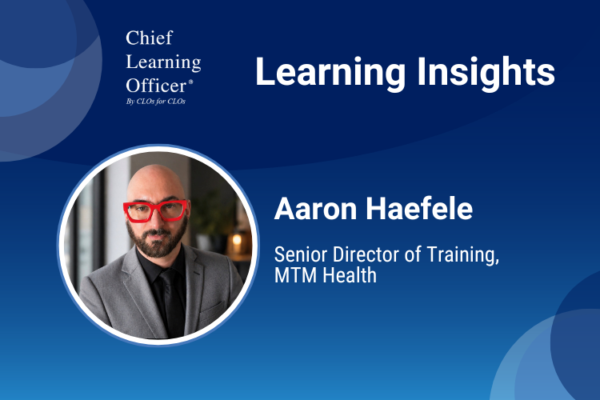

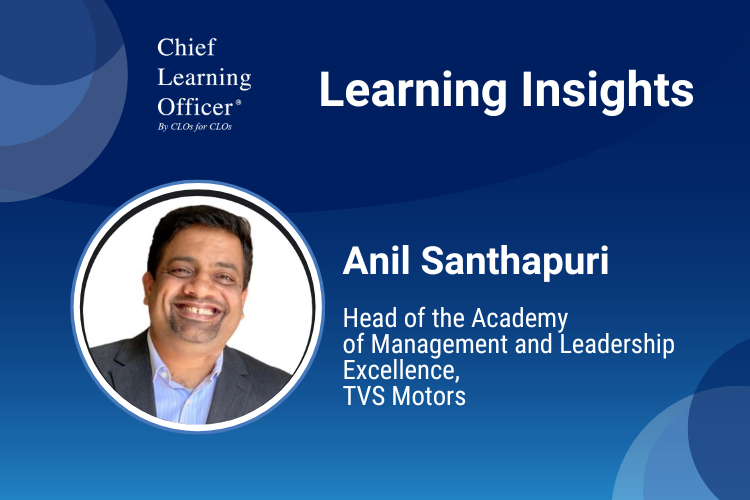
Chief Learning Officer’s “Learning Insights” series is dedicated to showcasing the thoughts and career journeys of chief learning officers and learning executives—the tireless trailblazers who are transforming the landscape of corporate learning and workforce development. In this Q&A series, we garner strategic insights, innovative approaches and challenges overcome from visionary leaders worldwide.
CLO: What initially drew you to a career in learning and development, and how have your experiences evolved over the years?
My journey into learning and development was neither planned nor incremental—it was a pivotal career decision. Early in my career, while working in an IT role, I had the opportunity to meet a chief learning officer, Ed Cohen, whose work deeply inspired me. The breadth of what he was doing—shaping organisational culture, building leadership capability, and driving strategic change through learning—resonated with something I had always been drawn to but had not yet articulated. I reached out to him, pursued an internal job rotation and made the transition from IT to L&D.
That single decision set the trajectory for everything that followed. Over the years, I have had the privilege of working across multiple multinational corporations—setting up, launching and relaunching L&D functions and leading talent and leadership development agendas for organizations ranging from 2,000 to over 20,000 employees. My experience spans geographies—the Asia Pacific, the Americas, the Middle East and Africa—and includes integral roles in shaping Corporate Universities at Mahindra Satyam, Western Union and now TVS Motor Company.
Each of these experiences has reinforced a core belief: Learning, when positioned strategically, is not a support function—it is a transformation engine for the enterprise.
CLO: What key initiatives have you implemented as a learning leader to drive employee development and foster a learning culture?
Two initiatives stand out as defining moments in my career:
- Leading the digital learning transformation at scale during the COVID-19 period, while heading the learning function at CGI for the APAC region—serving over 20,000 employees—there was an urgent need to migrate entirely to digital learning while sustaining a vibrant culture of continuous development. We made a strategic decision to pursue the adoption of a learning experience platform as the centrepiece of this transformation. Through a carefully orchestrated series of change management initiatives—spanning digital adoption, stakeholder engagement and behavioural nudges—we achieved LXP adoption rates exceeding 80 percent, with the average employee investing more than 40 hours per year in structured learning. This was not merely a technology migration; it was a cultural shift in how people experienced and valued learning.
- In my current role at TVS Motor Company—the third-largest two-wheeler company globally—I had the opportunity to establish the Academy for Management and Leadership Excellence, which was founded with a clear strategic mandate: to build a future-ready workforce by creating a robust leadership succession pipeline aligned to the enterprise’s talent architecture. A comprehensive suite of initiatives has been undertaken—from managerial capability development programs to talent-aligned, high-potential leadership development journeys, designed and delivered in partnership with leading business schools in India and globally.
CLO: What is the most impactful learning program you’ve introduced in your organization, and how has it contributed to employee growth and business success?
In my current organization, the most impactful initiative has been our senior leadership development program—Global Programme for Management Development (GPMD)—designed in direct alignment with our leadership succession strategy that creates measurable impact in terms of succession readiness, talent mobility and strategic execution, taking us closer to our enterprise vision.
Delivered in partnership with a leading university in the United States, GPMD is an eight-month hybrid learning journey for senior leaders identified as high-potential. The programme comprises two intensive contact weeks spread apart by six months, during which participants engage in a highly curated, customised curriculum. Between these contact weeks, participants take on real business challenges in the form of Action Learning Projects, each sponsored by a member of the business leadership team. The outcomes of these projects are presented directly to the CXOs of the organization, ensuring that learning translates into enterprise value.
Two elements make this program truly distinctive:
- Purpose-led leadership: A core design principle of GPMD is to develop leaders who lead with purpose—grounded in the values, ethos, and legacy of TVS Motor Company. The program includes a three-day rural immersion—a total immersion in our corporate social responsibility activities—where leaders engage directly with the communities and environments that have shaped our organization’s evolution. This experience deepens their understanding of the value system that underpins everything we do and cultivates a leadership mindset that is anchored in purpose, empathy and societal responsibility. Importantly, these communities also represent a significant segment of our customer base, making the immersion a powerful exercise in market understanding—enabling leaders to appreciate the aspirations, needs, and realities of the customers we serve.
- Disruptive thinking: At the heart of GPMD is a deliberate emphasis on cultivating disruptive thinking—the ability to challenge dominant thinking and reimagine how the organisation creates value. The action learning projects participants undertake are designed around real, future-oriented business challenges—exploring new business models, reimagining customer experiences, accelerating digital transformation or unlocking operational efficiencies at scale. By placing senior leaders at the intersection of academic rigour and live business complexity, the program builds a leadership cadre that does not merely respond to disruption but actively drives it—making learning a direct catalyst for enterprise innovation and strategic differentiation.
Over the past couple of years, this program has been a significant contributor to strengthening the succession pipeline for critical roles across the organization.
CLO: What is a common misconception people might have about the L&D function, and how do you address it?
There are several misconceptions about L&D, but the most persistent one is that it is easy, surface-level work—essentially organizing one-off events. In common parlance, we sometimes hear it described as “song and dance”—a view that L&D exists to energise tired teams or fill time between business cycles. That characterization fundamentally underestimates what learning can and should accomplish.
Having had the opportunity to work with three corporate universities across my career, I can share with conviction that L&D can and should focus on institutional capability creation. The work we do in our current organization is a testament to that belief—it is deep and progressive, spanning behavioural change, managerial capability, leadership succession and cultural transformation. This is especially critical today in the context of the future of work, where the pace of disruption demands that we continuously reimagine how we lead, manage and keep the customer at the center of everything we do.
Beyond program delivery, I believe all L&D functions and professionals should invest seriously in understanding adult learning pedagogies, learning sciences and emerging research on how people learn, collaborate and change. Equally important is the need to proactively integrate evolving learning technologies into our solutions. With the advent of AI, the way humans think, interact and collaborate is shifting in fundamental ways—making change management a core competency for any learning professional, not a peripheral activity.
Learning, at its best, is a nexus of the humanities—psychology, anthropology, behavioural science and organizational development. Most people do not fully appreciate that depth, and it is our responsibility as learning leaders to demonstrate it through the rigour and impact of our work.
CLO: What excites you the most about the future of workplace learning, and how are you preparing your organization to adapt to the changing landscape?
What excites me most is that workplace learning is moving from the periphery to the very core of enterprise strategy—and our corporate university embodies that shift, having evolved into a strategic transformation hub powering TVS Motor Company’s global leadership in mobility.
In preparing our organization for the changing landscape, we operate at a systems level—integrating functional and domain expertise, cultural capabilities unique to our organization and the behavioral nuances needed to navigate disruptive change. We call this our integrated competency approach. Whether it is addressing the evolving demographics of India and our global workforce, or leading the integration of AI and emerging technologies into the way we work, learn and collaborate, we are at the nexus of all of it.
Concretely, we are actively building current and future individual and collective capabilities from a behavioural perspective, strengthening the culture of the organization, developing management capability and leadership succession pipelines and enabling AI adoption as a cultural imperative—not merely a technology initiative. Each of these is a deliberate response to the forces reshaping the world of work, and together they form our roadmap for keeping the organization current and future-ready.
These are genuinely exciting times. The opportunity to shape how an enterprise thinks, learns and transforms at this scale is both a privilege and a responsibility we all should take seriously.
CLO: What essential qualities or skills make a successful L&D leader, and how do you cultivate these traits in yourself and among your team?
A strong foundation in learning sciences and pedagogies is essential—that is non-negotiable. But what truly differentiates an effective L&D leader is the ability to hold two perspectives simultaneously: An inside-out view of the organization’s business, strategy and culture, and an outside-in view of how geopolitical, macroeconomic and technology trends are reshaping the competitive landscape.
The critical capability is systems thinking—the ability to synthesise these perspectives and determine what cultural and individual capabilities the organization needs to build for the short, near and long term. From there, it is about influence—the ability to work with senior leaders and CXOs to co-create the future, to co-design the solutions. In many ways, it is about wielding what I call “soft power”—engaging all critical stakeholders to move toward the change the organization needs to make.
How do I cultivate these skills within my team? We are actively embedded in these initiatives, so every day is a lived learning experience. But beyond daily work, I ensure that every team member undertakes a couple of crucible experiences each year—stretch assignments that take them into unfamiliar territory, whether it is leading a project they have not done before or solving a problem they have never encountered. We also actively engage with internal and external experts, subject matter specialists and academic partners to build on their expertise and accelerate the velocity of our learning and leadership solutions.
Complementing this with developmental conversations around these crucible experiences is how we integrate these skills into the team’s culture.
CLO: What game-changing advice would you offer if you could go back in time and mentor your younger self?
When I reflect on my younger self, I recognise that one of the best decisions I made was also one of the most audacious. Meeting that CLO, trusting in the work he was doing and choosing to leave behind a well-established IT career to follow a conviction—that was, by any conventional measure, a leap of faith. To borrow the phrase: “Stay hungry, stay foolish.”
That bold career shift from IT to HR, at a time when it was far from fashionable, taught me something fundamental: The most meaningful professional growth comes from choices that are aligned to your convictions, your values and your strengths—even when they appear unconventional.
The second piece of advice I would offer is this: Actively invest in finding mentors—both life mentors and career mentors. Having trusted sounding boards who can offer perspective, wisdom and counsel when you feel stuck is invaluable. That external viewpoint helps you make better choices from any given situation.
I would also caution against a common trap: expecting your manager to automatically play the role of mentor, coach, sponsor and champion. These are distinct relationships, and they require intentional effort to cultivate. I would encourage everyone to actively seek out sponsors and champions within their respective organizations—they make all the difference in accelerating your growth and amplifying your impact.
CLO: What do you feel is currently the single biggest challenge facing L&D professionals and the industry as a whole?
The single most pressing challenge for L&D functions today is relevance—and it must be addressed from two dimensions, in sequence:
- Transform from within. L&D functions must actively demonstrate relevance by adopting and integrating the macro trends reshaping the world of work—particularly the advent of generative AI and broader AI technologies. AI is fundamentally changing the way we think, act and interact—as individuals, as teams, and as organizations. We must first transform the way we work, the tools we use and the solutions we design from within our own functions. If we cannot model the change we advocate, we lose credibility.
- Lead the enterprise transformation. Once we have transformed ourselves, relevance comes from our ability to act as change agents—leading from the front to drive the changes organizations need to make in their ways of working, technology adoption, business models and culture. Given how profoundly AI is reshaping human behavior and collaboration, L&D is uniquely positioned to lead this transition—but only if we have first lived it ourselves.
These two dimensions must happen in that order. First, we change from within. This is the most urgent challenge we face—right now, today. If the traditional L&D function cannot make this shift, it may not have a place in the organization of the future.
Interested in being featured in our “Learning Insights” series? Please complete this FORM.