

I keep coming back to a question as learning leaders prepare for 2027: Where is the capacity for all of this supposed to come from?
Employees are being asked to learn how to work with artificial intelligence, adapt to new workflows, develop new skills, navigate organizational changes and continue delivering results. None of those expectations are unreasonable on their own. The problem is that they are happening at the same time.
Deloitte reports that the average worker now experiences 10 planned enterprise changes each year, compared with two in 2016. About two-thirds of workers globally say they are overwhelmed by how quickly work is changing, and nearly half worry that the pace of change will leave them behind.
At the same time, the capabilities organizations need are changing quickly. PwC’s 2026 Global AI Jobs Barometer found that the skills required in the jobs most exposed to AI are changing more than twice as fast as those in the least exposed jobs.
As an industry, we have spent a great deal of time talking about whether organizations can provide learning fast enough. I think we may be asking the wrong question.
The issue increasingly isn’t access to learning. It is whether people and organizations have the capacity to absorb what we are asking them to learn and turn it into performance.
For me, that is the distinction that should shape the learning agenda for 2027.
The capacity problem
When I use the term workforce capacity, I am referring to an organization’s ability to absorb change, develop the capabilities it needs and translate those capabilities into sustained performance. Organizational capacity is ultimately expressed through individual capacity. When employees run out of time, energy or opportunity to practice, the organization’s capacity to adapt shrinks as well.
Capability and capacity are related, but they are not the same thing. Capability tells us whether people can do what the organization needs them to do. Capacity determines whether the organization can create the conditions for enough people to learn, adapt and perform at the pace required. That distinction matters because content is no longer particularly scarce.
AI can generate explanations, practice activities, simulations and performance support almost instantly. Learning platforms can recommend resources based on roles and skills. Employees can access expertise and information now when they need it, and in ways that were difficult to imagine only a few years ago. What remains scarce is time, attention, energy and the opportunity to practice. That makes me wonder whether organizations may inadvertently be contributing to some of the capability gaps they are trying to solve.
A new technology changes work. A capability gap appears. We respond with training. Employees complete that training while continuing to meet their existing performance expectations and absorb other changes. They may understand the new skill but have little time to practice it, receive feedback or incorporate it into their work.
When performance does not change quickly enough, our instinct may be to add more learning. Learning activity and workforce capability are not the same thing. That should cause us to ask a different question before we build the next program: What performance problem are we trying to solve?
Personalization should reduce friction
Personalized learning will rightly remain a priority in 2027. AI gives us an extraordinary ability to tailor learning at scale. But I think we need to be more precise about what we are trying to personalize. It is relatively easy to personalize content. We can recommend different courses, resources and pathways based on an employee’s role, interests or existing skills.
But a better recommendation engine does not necessarily produce better performance. The more interesting opportunity is to personalize around the gap between current and required capability.
What does this person need to be able to do? What can they already do? What is getting in the way? When will they need the capability? And what is the least burdensome intervention that will help them develop or demonstrate it?
This changes the goal of personalization. We are no longer trying to create an elaborate individual curriculum for every employee. We are trying to find the shortest credible path between current capability and required performance.
Sometimes that path will be a course. Sometimes it will be coaching, practice, feedback, job shadowing or a stretch assignment. Sometimes an AI-enabled tool can provide support while the employee performs the task.
And sometimes, we may discover that the problem does not require learning at all. The better intervention may be clearer expectations, a redesigned workflow, better technology or a management decision. That requires learning leaders to diagnose before we prescribe.
The business need is already clear. LinkedIn’s 2025 Workplace Learning Report found that 49 percent of learning and talent development professionals surveyed said executives were concerned that employees lacked the skills needed to execute business strategy.
Closing that gap will require more than a larger catalog of learning opportunities. It requires a much closer connection between learning, work and performance.
The conditions for capability
This is also why I think energy management, resilience and psychological safety need to be part of the learning conversation in 2027.
They are often discussed as employee experience or wellness issues. Those conversations are important, but there is another dimension that learning leaders should consider: They affect whether people can develop and apply new capabilities.
Think about psychological safety. Employees who believe they should already know the answer may be less willing to ask questions. People who fear the consequences of making a mistake may be less likely to experiment with an unfamiliar approach. If employees cannot comfortably acknowledge what they do not know, capability gaps also become harder for the organization to identify.
The same is true of resilience. I worry about using resilience as a way of describing how much change employees should be able to tolerate. Resilience should not become an expectation that people simply absorb whatever organizations place in front of them.
With workers encountering an average of 10 planned enterprise changes a year, according to Deloitte, we must consider the cumulative demand we are creating.
Every new capability competes for finite attention, energy and time. This means that when a learning initiative struggles, we need to look beyond the learning experience itself.
Did employees have an opportunity to practice? Did managers reinforce the new behavior? Did the workflow support it? Did employees feel safe experimenting? Were there competing priorities? Was there actually enough time to integrate the new capability into the work?
These are not always problems a learning team can solve independently. But they are conditions learning leaders need to see.
Reskilling without continuous training
Continuous reskilling may be one of the defining workforce challenges of the next several years.
PwC’s 2026 analysis helps illustrate why. Beyond finding that skills are changing more quickly in AI-exposed jobs, PwC found that new tasks in those roles are increasingly demanding human capabilities such as judgment, empathy and creativity. Even junior AI-exposed roles are increasingly requiring capabilities traditionally associated with more senior work, including leadership and strategic thinking.
We are developing people for work that will continue to change. However, continuous reskilling cannot become synonymous with continuous training.
Employees do not have unlimited time to take courses, and completing a course does not tell us whether someone can perform differently afterward.
I think learning leaders have an opportunity to rethink where development happens.
More of it can happen through authentic practice, coaching, feedback, internal mobility, peer expertise and performance support embedded directly into work. AI may accelerate that shift by making guidance and feedback available when an employee needs them.
There is an interesting paradox here: While AI helps cause the skill disruption that makes continuous development necessary, it simultaneously gives us tools that could make development faster and more targeted.
The question is what we do with that capability.
We can use AI to produce more content, or we can use it to reduce the effort required for someone to become capable.
Those are not necessarily the same thing.
Some of the most valuable uses of AI for learning may ultimately eliminate unnecessary learning. If an employee can receive reliable guidance in the workflow for an infrequent task, perhaps we do not need to ask that employee to remember information they can access when they need it.
That requires us to get comfortable with saying something learning and development professionals have not always been rewarded for saying: This isn’t a learning problem.
A different agenda for 2027
I have been thinking about these issues as a workforce capacity loop.
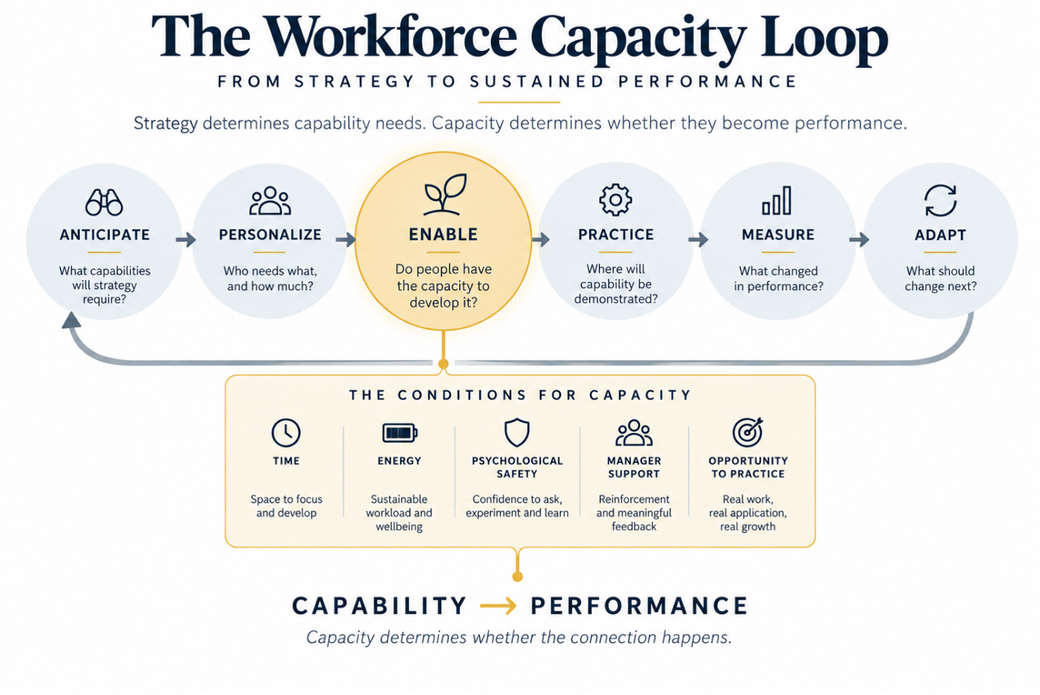
Note. Conceptual framework developed by Sandra Mohr. Figure created by the author with generative AI assistance using OpenAI ChatGPT (2026).
The model begins with strategy. What capabilities will the organization need? It then asks who needs those capabilities, what is preventing development, where people will have an opportunity to practice, how performance will be assessed and what should change based on what we learn. But the part of the loop I think deserves much more attention is enable.
We can identify a capability gap correctly. We can design excellent learning. We can provide sophisticated technology. None of that guarantees that an employee has the time, energy, managerial support, psychological safety or opportunity to turn learning into performance. That is where capacity enters the equation.
For learning leaders, this creates a useful test before launching another initiative:
- What performance problem are we trying to solve?
- Is lack of capability causing it?
- Does the solution require learning, or could performance support, AI assistance, workflow redesign, better tools or management intervention work better?
- What conditions need to exist for people to develop and apply capability?
- What evidence will tell us that performance actually changed?
These questions may lead us to build fewer learning programs. I think that could be a sign of progress.
For decades, learning leaders have worked to expand access to development. In 2027, access may increasingly become the easier part. AI will continue making knowledge, guidance and personalized support more readily available.
Our harder job will be deciding what people need to learn, creating the conditions in which they can learn it, helping them apply it and protecting enough organizational capacity for adaptation to occur.
Sometimes the answer will be a course. Sometimes it will be coaching or practice. Sometimes AI should provide support in the flow of work. Sometimes the organization needs to change the work itself.
The organizations that get this right may not be the ones that provide the most learning. They will be the ones that build the capabilities that matter, at the pace they are needed, without exhausting the people expected to develop them.
That is the question I think learning leaders should carry into 2027: How do we build the capabilities our organizations need without exhausting the capacity required to develop them?
Learning is abundant. Human capacity is not.